
-
 GALILEI, Galileo.
£53,950.00
GALILEI, Galileo.
£53,950.00 -
MUSTAFA IBN ABD AL-RAHMAN.
£36,000.00
-
VILLE, Antoine de.
£4,500.00
-
PISO, Willem et al.
£6,750.00
-
DE GHEYN II, Jacob.
£17,500.00
 GALILEI, Galileo.
£53,950.00 MUSTAFA IBN ABD AL-RAHMAN.
£36,000.00 VILLE, Antoine de.
£4,500.00 PISO, Willem et al.
£6,750.00 DE GHEYN II, Jacob.
£17,500.00
GALILEI, Galileo.
£53,950.00 MUSTAFA IBN ABD AL-RAHMAN.
£36,000.00 VILLE, Antoine de.
£4,500.00 PISO, Willem et al.
£6,750.00 DE GHEYN II, Jacob.
£17,500.00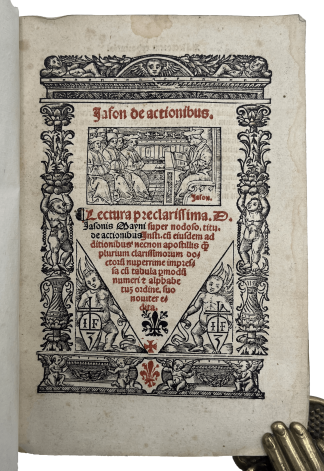
MAINO, Giasone del.
UNRECORDED IN US, CONTEMPORARY NOBLE PROVENANCE
MAINO, Giasone del. De actionibus, lectura.
Lyon, Antonius de Ry for Jacobus Franciscus Giunta, 10 February 1523.£2,250.00
8vo. ll. (xxxvi [index]) 248. Gothic letter, text in double column. T-p in red and black within architectural woodcut border, cherubs with Giunta’s initials, small woodcut depicting del Maino lecturing to students, similar small woodcut to first leaf of text (a1r), depicting books on a swivelling lectern and writing materials. Woodcut initials. Small light waterstain to upper blank margin of first quire, intermittent light spotting, a few ll. browned, a good copy in contemp. limp vellum on alum-tawed supports (a few missing), a little soiled with slight losses at outer edges, spine guards from late C14 or early C15 French probably legal text, rubricated with initial in blue. Contemp. shelfmark ‘79’ in ink to upper cover, paper shelfmark label to foot of spine, some loss, ‘79’ visible in red paint. Contemp. title, autograph and coat of arms of ‘Johann Jacob Römer a Maretsch’ in ms. to top edge, autographs to ffep of Johann Jacob, with three-letter subscription possibly in code (price note?), and ‘Hans Jacob Römer zü Maretsch,’ dated 1541, in red ink with Greek (and German?) motto including rebuses (possibly for names) of pointing hand and love heart, ‘Kaine Alou T{hand}. Eou Rich[ardus?]. L{heart}. Alou,’ capitals accentuated, possibly meaning ‘look on/grasp nothing else(?),’ above an arrow piercing a heart, pen trials of pierced heart and arrowheads to ms. waste. Occasional contemp. annotations, a few in red ink (Hans Jakob’s?), underlining in black ink.
Very rare first Giunta edition of this work on legal actions in Roman civil law by the humanist jurist Giasone del Maino (1435-1519), first published 1483. It is a commentary on Book IV of the Institutiones, the student text-book of the Byzantine system of civil law promulgated by Justinian I. Del Maino states that all litigation occurs through legal actions, which enforce rights or obligations, the latter concerning contracts, and are always brought in relation to a property or an individual (in rem vs personam). Much of the work concerns contract law, including promises, usury, exceptions, etc. Del Maino describes the action that should be taken by judges in various cases. One of the crucial questions is whether legal causes can be inherited through marriage and descent etc., del Maino covering primogeniture, for example, as well as the rights of servants to bring actions against their masters, the rights of kings to alienate land, etc., obligations and rights of knights, etc. Del Maino also deals with actions responding to harmful acts (de maleficiis), including restitution.
This copy has intriguing and splendid contemporary noble Austrian provenance, being from the library of the Römer family of Maretsch in South Tyrol, held by tradition to be Roman emigrants, hence the name. The four sons of Christoph (d.1544) were Catholic courtiers, religious knights and magistrates who rebuilt the family castle at Maretsch in Renaissance style: ‘Kaspar Melchior (d. 1574) attended the Habsburg court of Graz. Christoph Sigmund (d.1571) was commander of the Knights Hospitaller in Mailberg, Lower Austria, and died as captain of Trieste. Lukas (d.1582) joined the Teutonic Knights in the early 1540s, became commander at Sterzing in 1552, and finally Tirolean commander in 1560. The most colourful of the siblings, Lukas resigned from the order in 1573, married his concubine, and petitioned the archduke for the legitimization of their five children. The archduke gave his fiat; but ecclesiastical dispensation, after initial approval, was withdrawn, as Lukas had allegedly bribed a Brixen cathedral canon. Lukas’s death provoked a lengthy legal battle over his inheritance, which was finally divided between the family and the order. Last Hans Jakob (1518-71) served the count as a local office holder and councillor, collected antiquities, and translated the Tirolean ordinance (Landesordnung) into Italian’ (M.A. Chisholm. ‘The Tirolean Aristocracy in 1567’ in Austrian History Yearbook, 40 (2009), p. 26). A cousin of the siblings, Johann Jacob, also confirmed as a baron, may be the Johann Jakob whose autograph can be found twice in this book. Chisholm states that he ‘displayed ancient Roman sculpture and artefacts’ (p. 22).
OCLC notes four copies of this edition, none in the US. USTC 145581. Baudrier VI, p. 113. Von Gültlingen III, 184.26.In stock