

Description
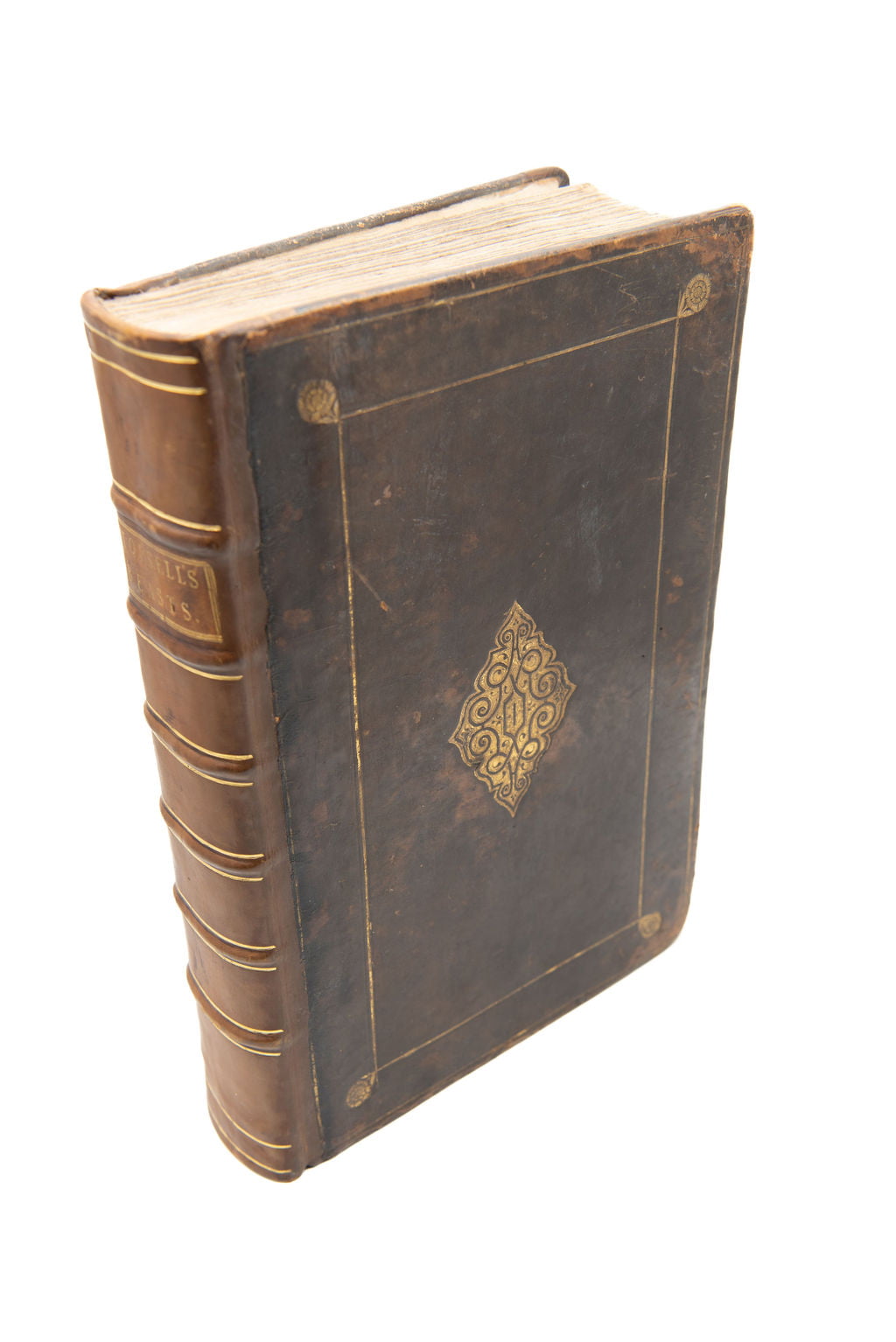
A very good, fresh copy, in a charming contemporary English binding, of the first editions of two attractively illustrated early English works of natural history. They are translations, with significant additions by Edward Topsell (1572-1625), of Books I (on quadrupeds) and V (on snakes and scorpions) of Conrad Gesner’s (1516-65) ‘Historiae animalium’ (1551-87), a very influential compendium of zoology. An epitome of all available knowledge on the animal kingdom, the ‘Historiae’ combined fabulous and real animals, and literary (proverbs, etymology) and scientific (behaviour, physical features, medical uses) material.
Topsell adapted Gesner’s work to entice a young English readership, becoming a key source for later children’s educational books. It was first and foremost an encyclopaedia of zoology, teaching which animals were useful and friendly to humans, as well as their traditional symbolism (e.g., rats are lustful and much more poisonous during copulation). Each section includes a zoological woodcut, a history of the animal’s name, anecdotes pertaining to its nature, habitat and character, and medical uses. E.g., the dried heart of an ape strengthens the heart; an antidote drawn from beavers helps against epilepsy. Topsell’s chapter on the horse is much longer and more detailed than Gesner’s. The work concludes with useful lexica of Latin, Italian, Spanish, French, German and Greek names for each of the beasts featured. The history of serpents, scorpions, lizards and insects – including spiders and bees, with a long section on their medicinal uses – begins with the ‘Divine, Morall and Naturall’ elements of serpents, acknowledging their problematic place in the history of creation, and moving onto a technical discussion of their anatomy. Topsell’s work improves on Gesner’s in its more consistent (and useful) inclusion of medical authorities and recipes for antidotes, albeit with a looser zoological taxonomy.
The handsome illustrations were partly drawn from Gesner’s ‘Historiae’ – especially the famous rhino, after Durer’s woodcut, ‘the outward shape and picture of [which] appeareth rare and admirable […], differing in every part from all other beasts, from the top of his nose to the tip of his tail’. Other sources include Thevet’s ‘Singularitez de la France antartique’ (1557), whence come the description and woodcut of the ‘Su’, ‘a wild beast in the new-found world’ whose skin was employed by the Patagonians. Topsell’s work also includes the first illustrated description of a giraffe in English. Most interesting are the woodcuts of the Crocuta, an Ethiopian quadruped with a human face and a lion’s body, of the sea serpents (with one devouring a ship), and the crocodile. A very good, clean copy of a much-read work, more often found defective or incomplete.
![[BIBLE].](https://sokol.co.uk/wp-content/uploads/2025/07/wholebook-1-324x482.png)
![[CONSEILLERS ET MAÎTRE GÉNÉRAUX DES MONNAIES.]](https://sokol.co.uk/wp-content/uploads/2020/07/L3503-2-324x897.jpg)

![[TAGLIENTE, Giovanni Antonio and Girolamo.]](https://sokol.co.uk/wp-content/uploads/2019/01/K164-8-324x500.jpg)