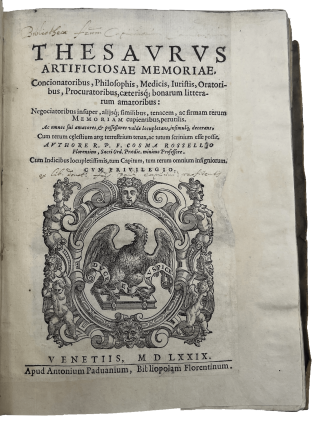

ROSSELLI, Cosimo.
DANTESQUE MEMORY SYSTEM, COPIOUSLY ANNOTATED
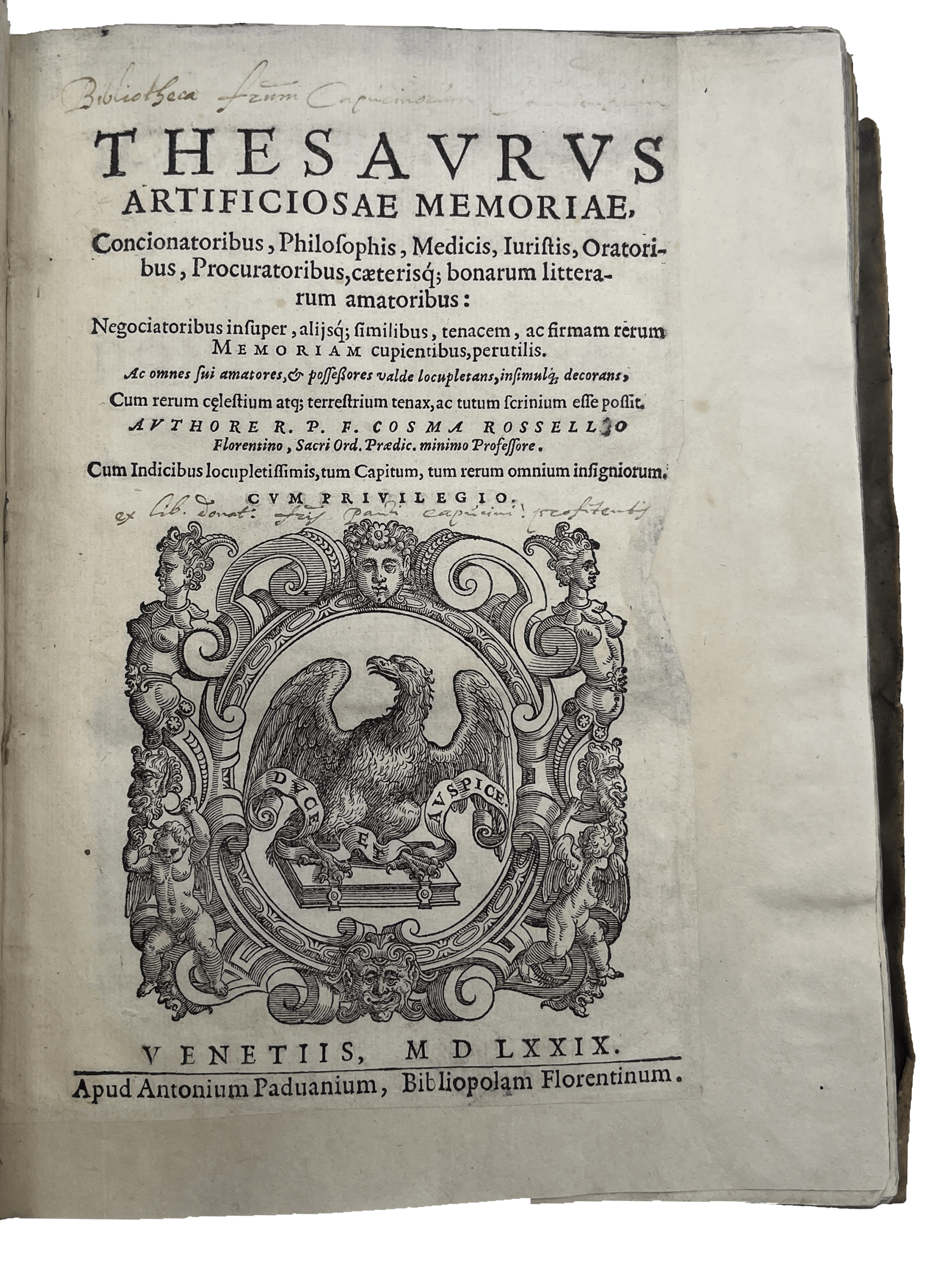
Thesaurus artificiosae memoriae.
Venice, apud Antonium Paduanium, 1579£3,950.00
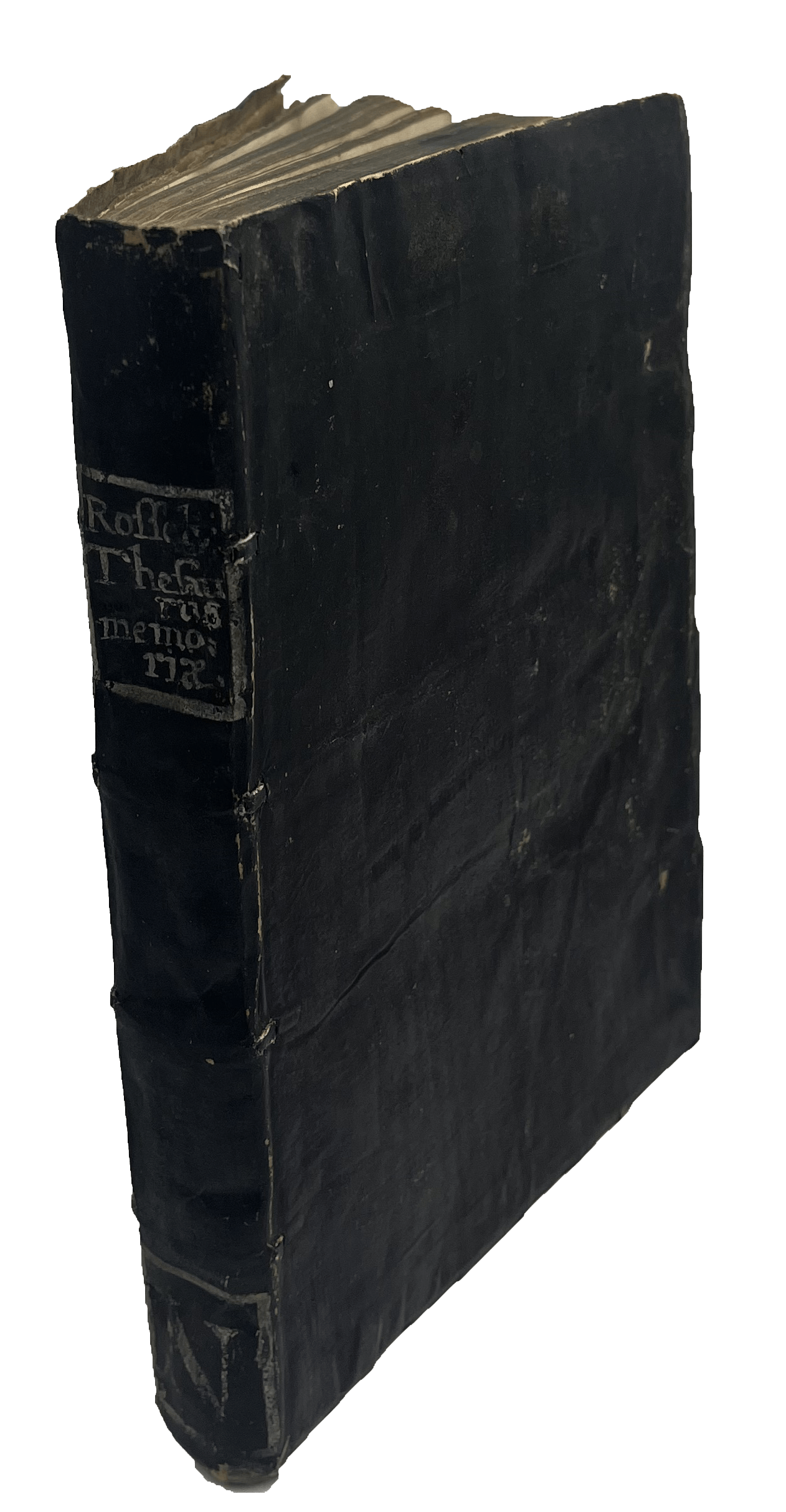
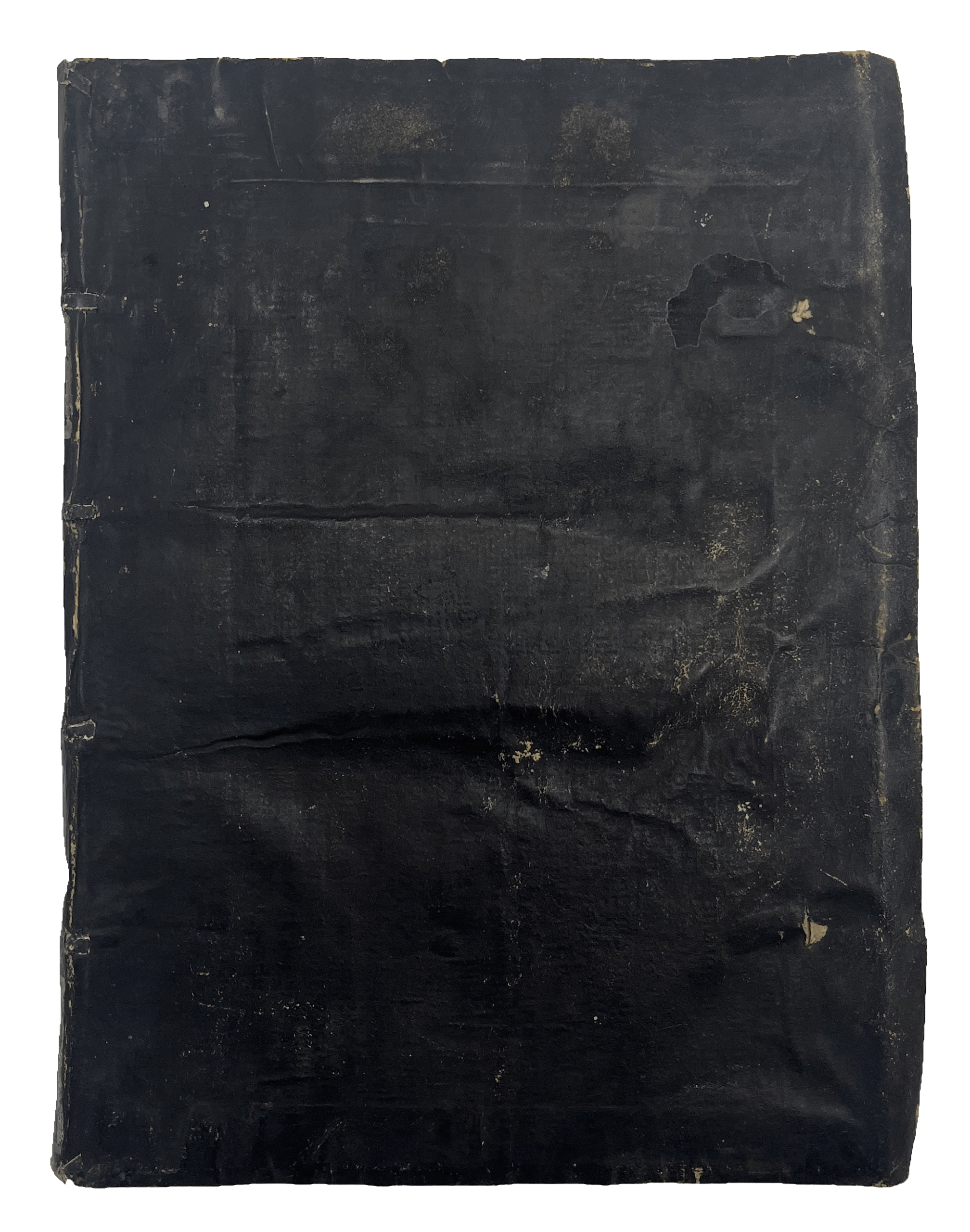
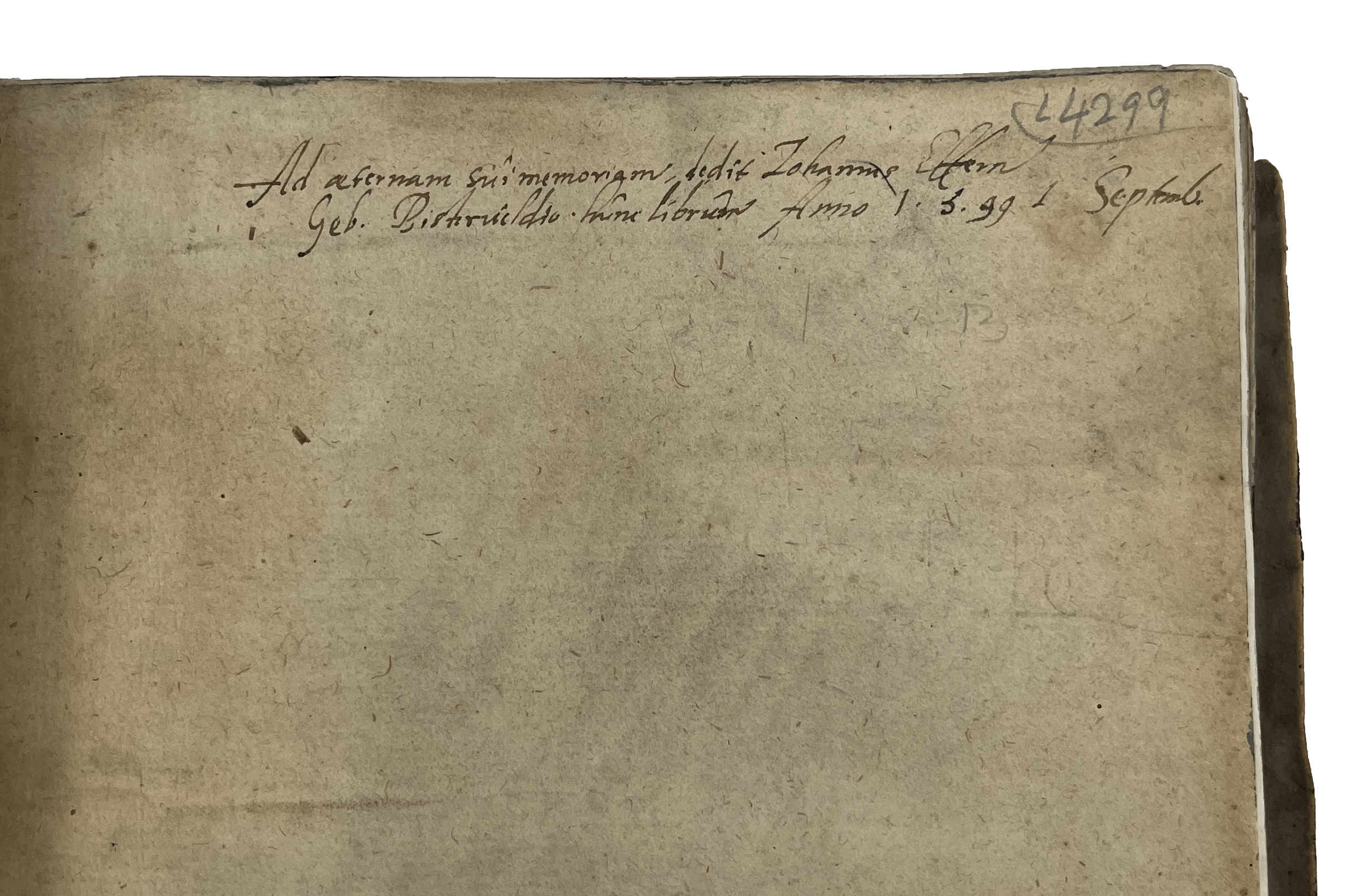
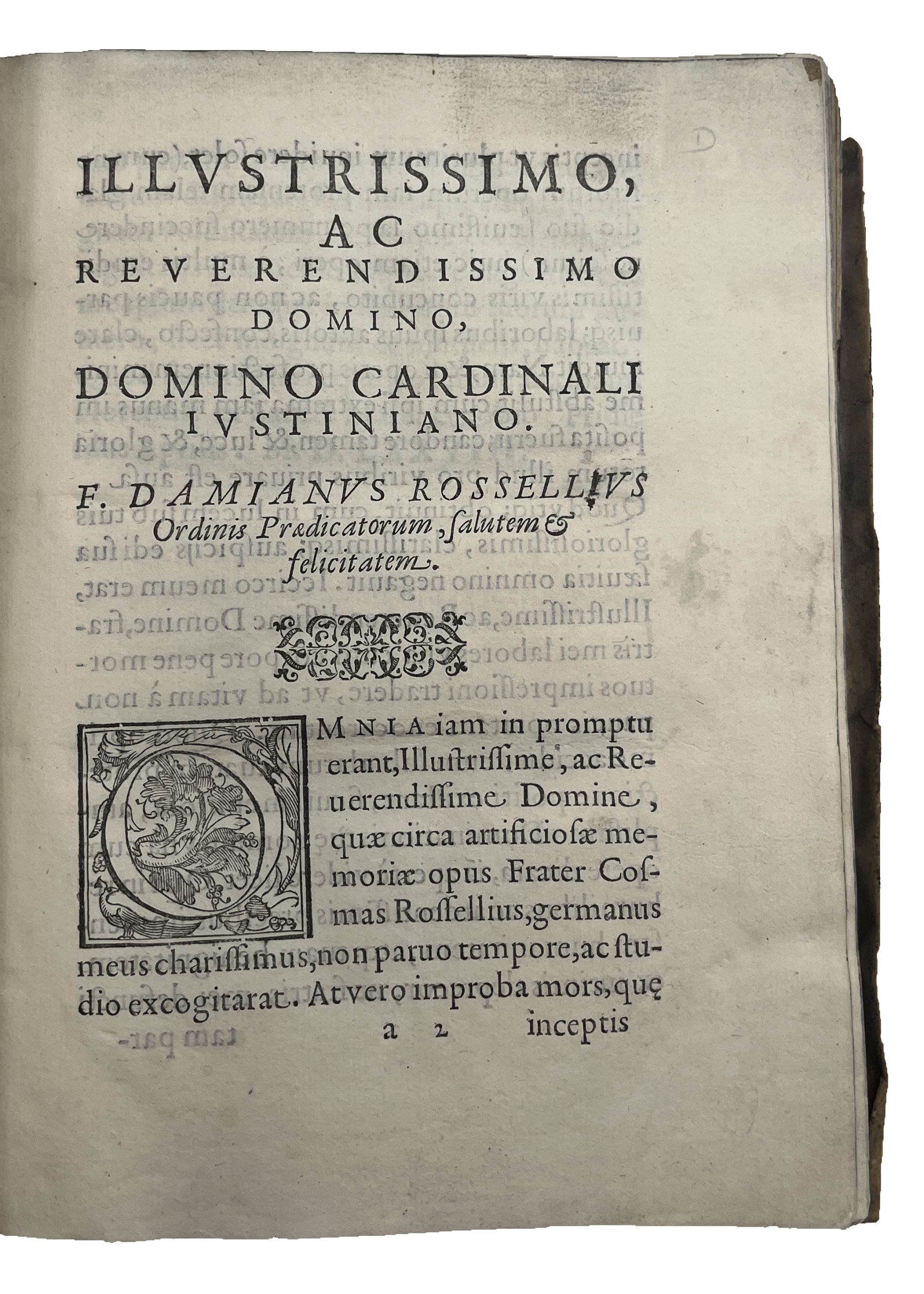
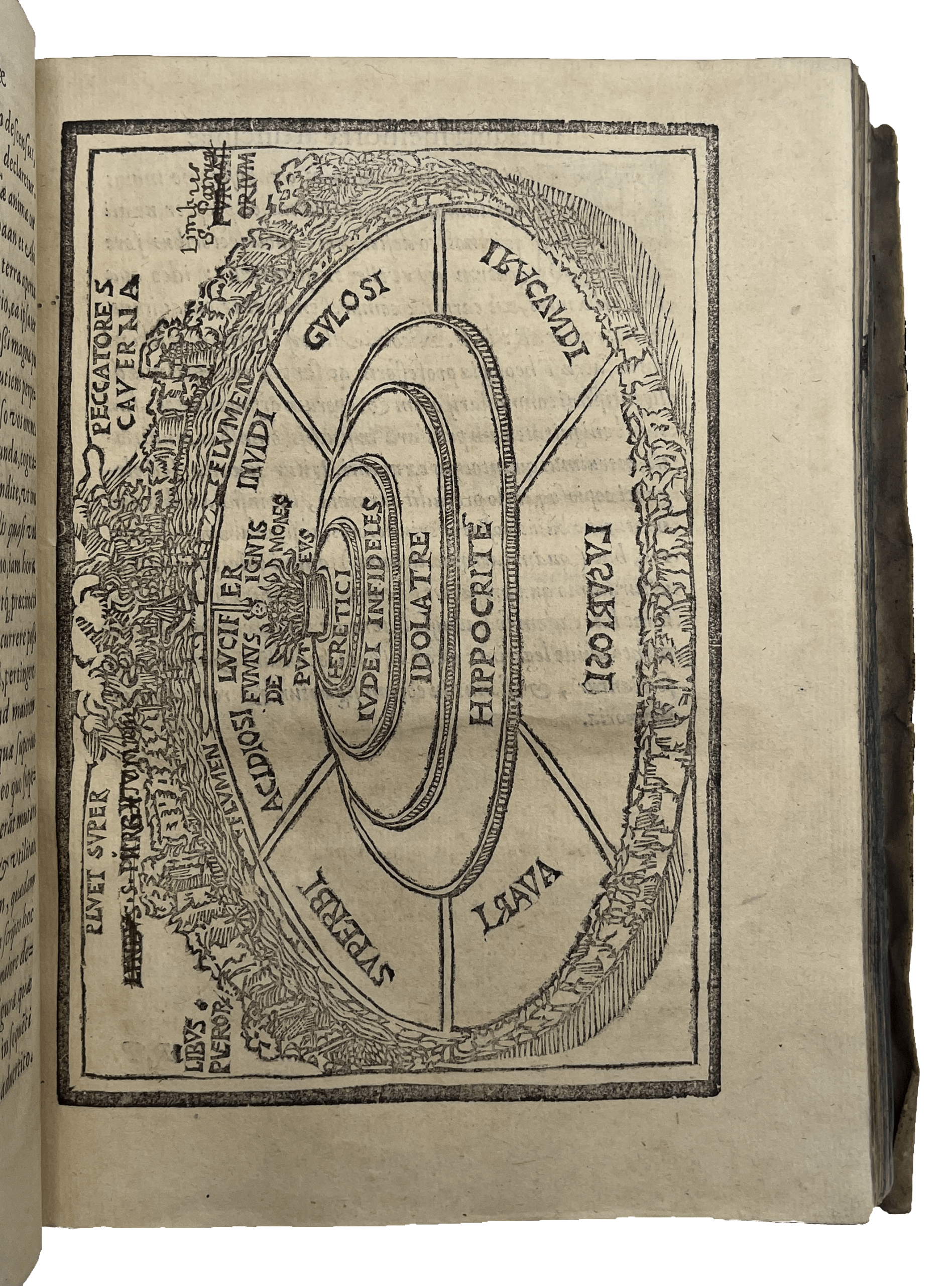
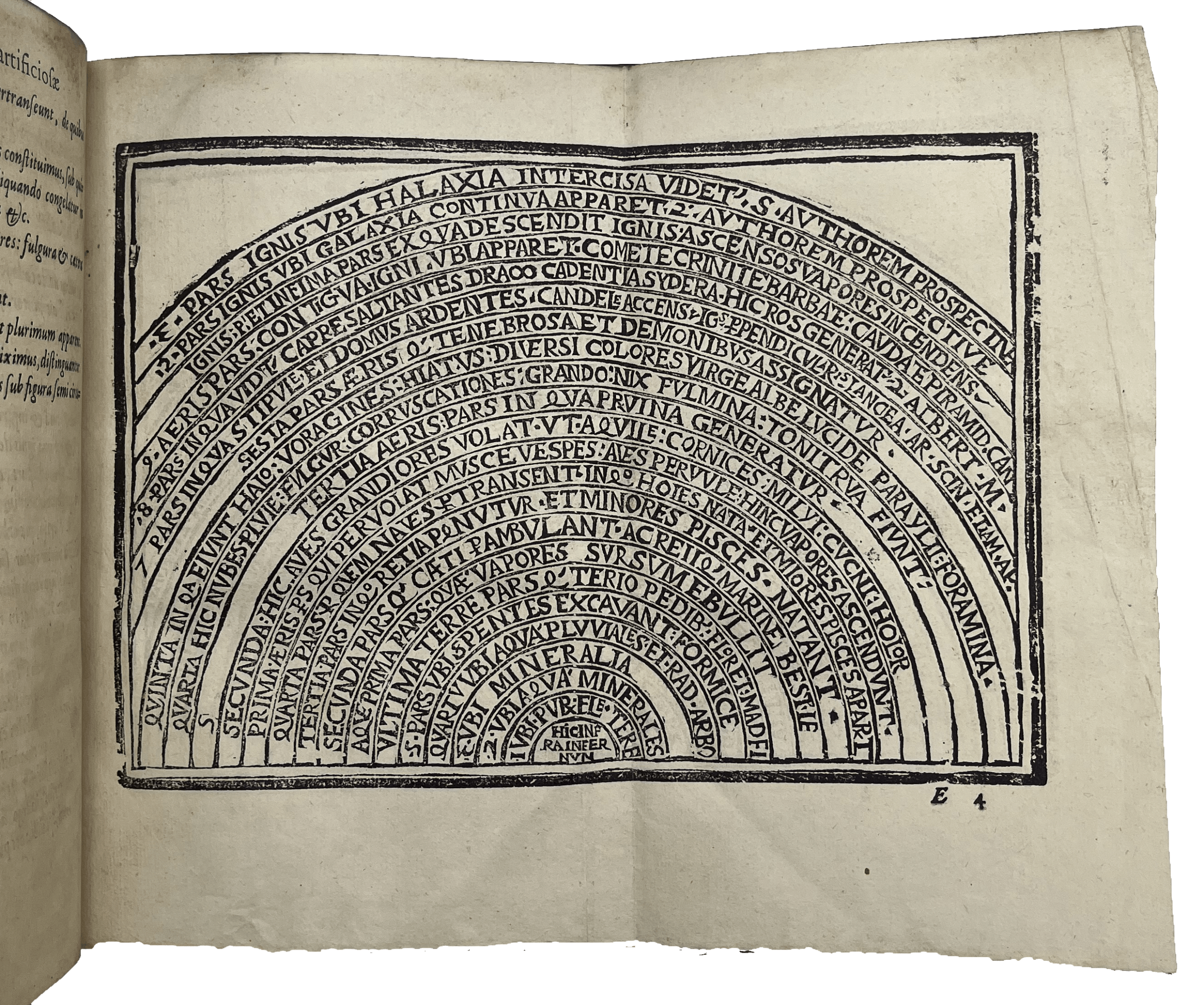
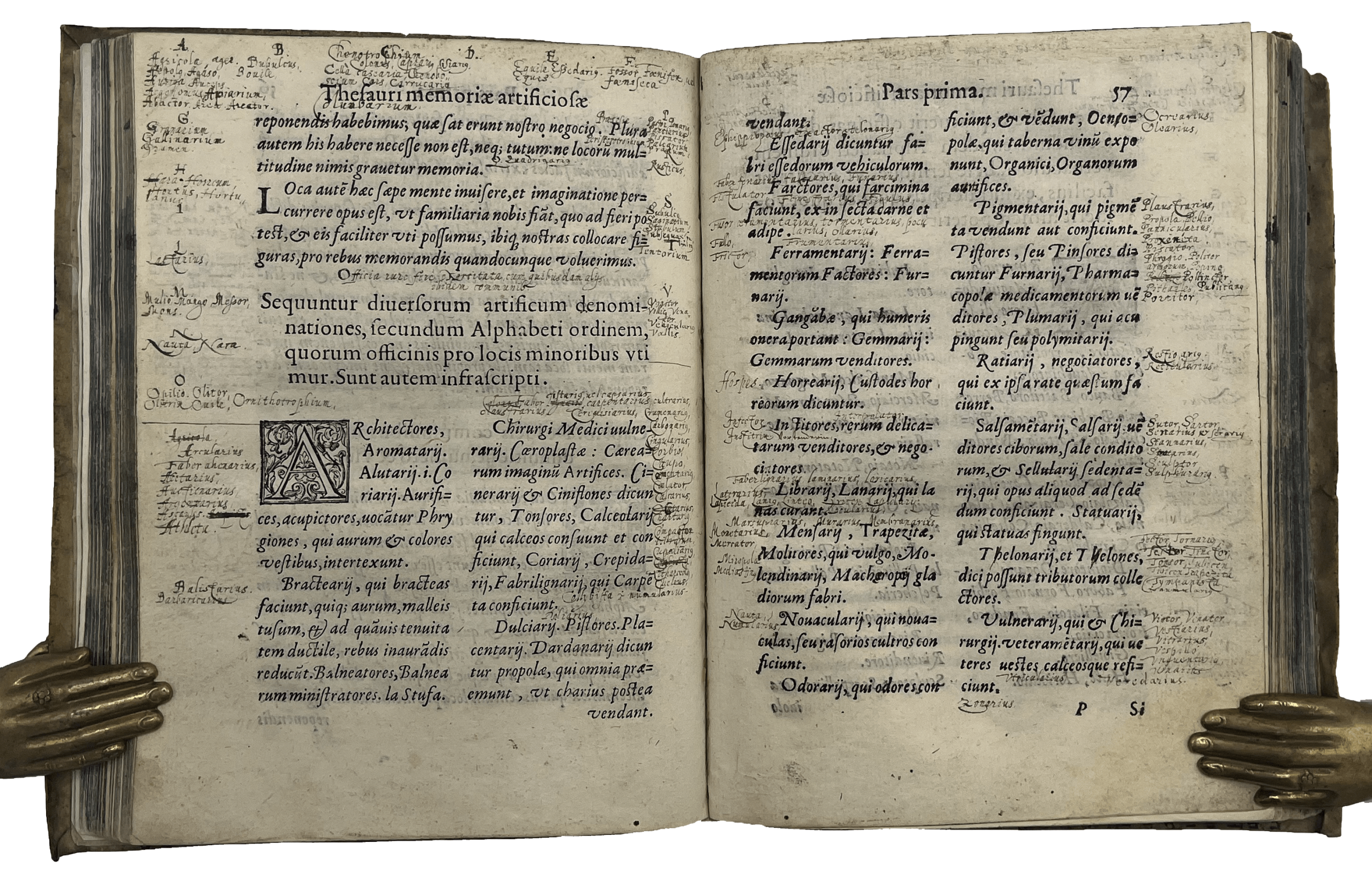
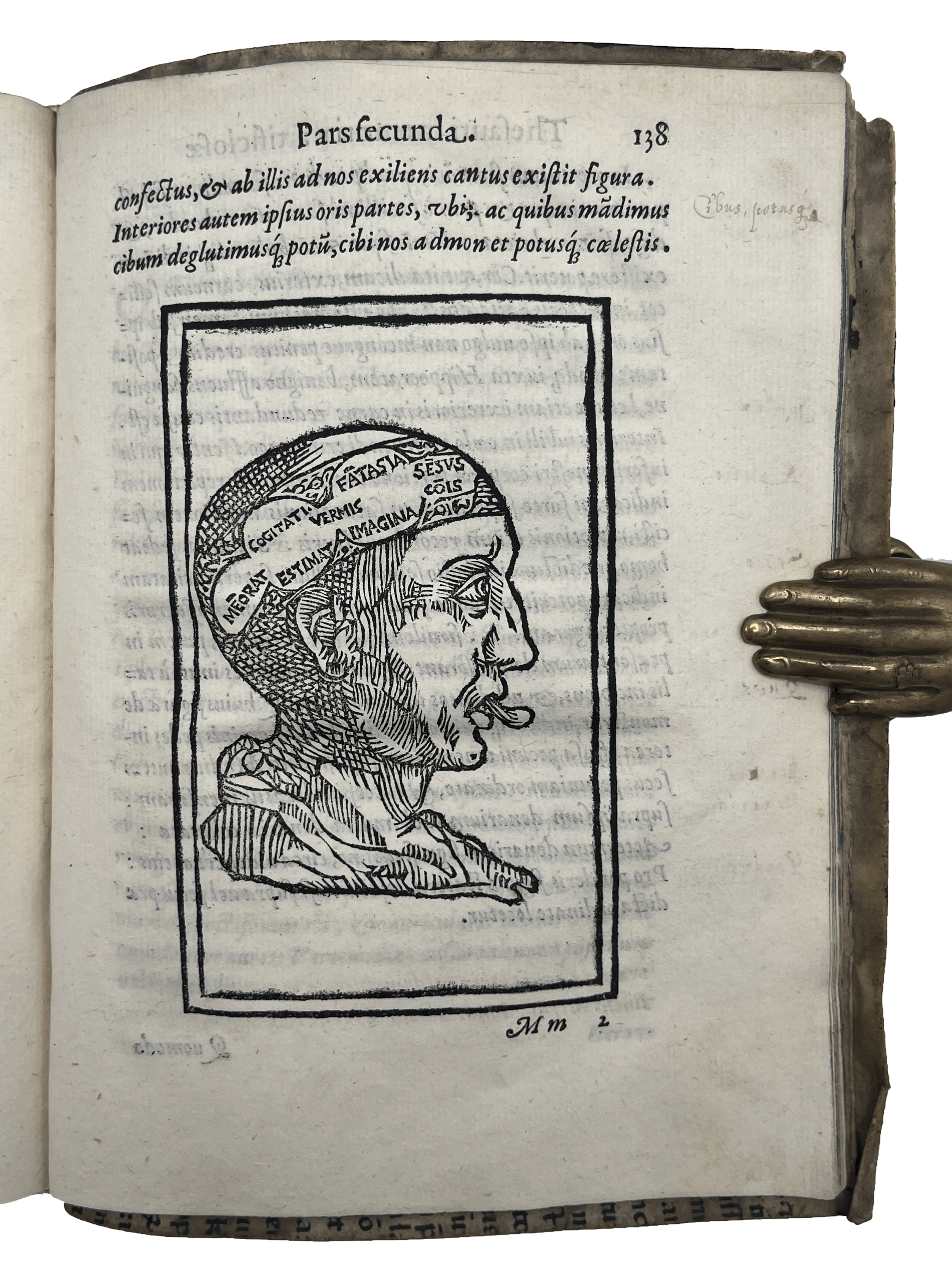
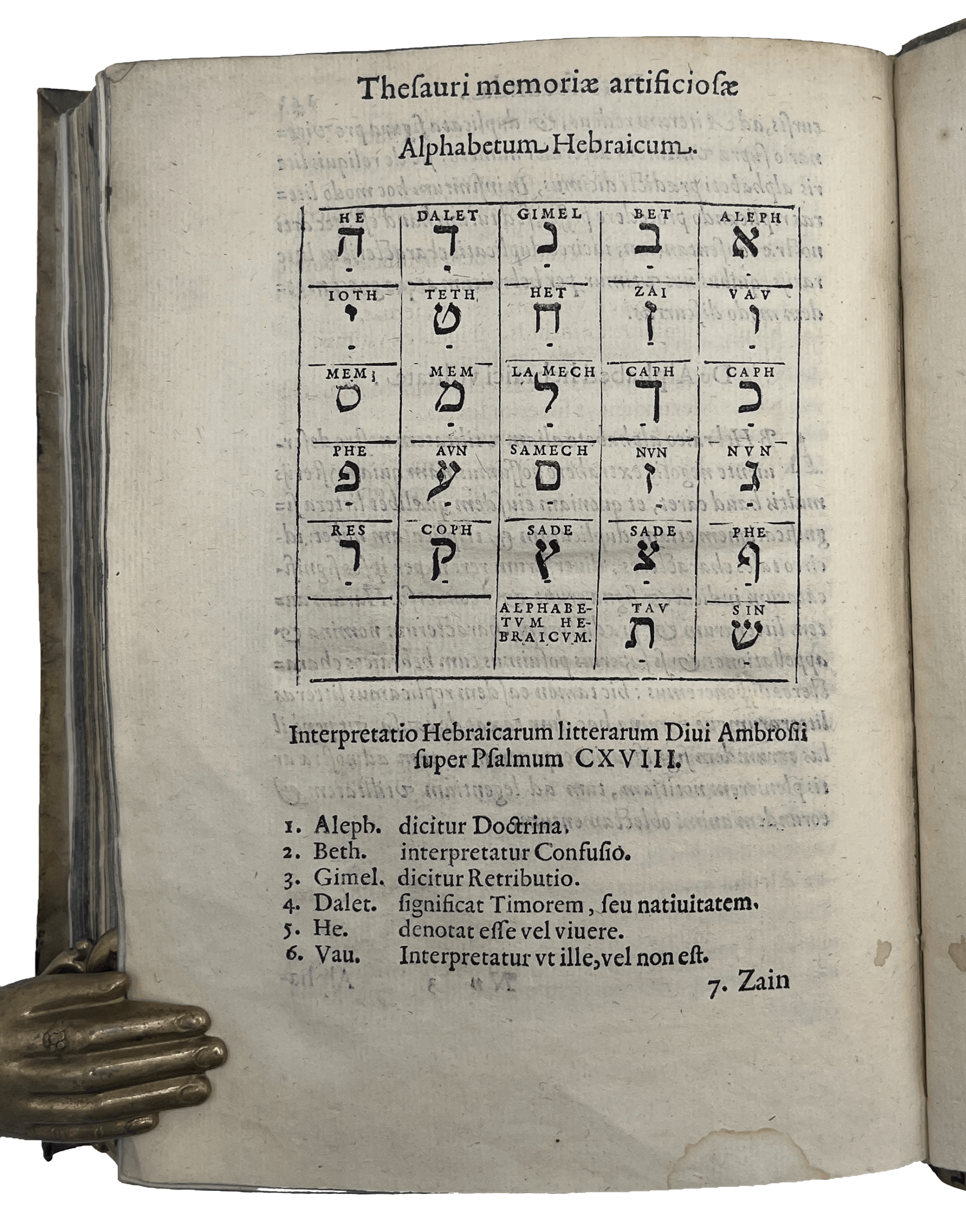
FIRST EDITION. 4to. ll. (xvi) 145 (i). Italic, Roman and Hebrew letter. One folding woodcut depicting memory theatre (included in register), twenty-six full page woodcuts depicting memory tables, pictorial memorial devices and plans, table to rear with Hebrew alphabet. T-p with woodcut printer’s device, woodcut initials and head-pieces. T-p outer and lower margins restored. Paper flaw to blank outer margin of E3. A few ll. browned, light age-toning, intermittent very light waterstain to lower blank corner, a very good, well margined copy in original limp vellum with printed incunable waste, painted black, title and shelfmark in white to spine, small loss from rear upper corner, edges stained blue. Inscription to front pastedown, ‘Ad aeternam sui memoriam, dedit Johannes Effern Geb[oren]. [place name] hunc libr[or]um Anno 1599 1 Septemb.’, possibly Johann von Efferen (d. 1606) of Stolberg Castle near Aachen, Germany, C17 inscriptions to t-p, ‘Bibliotheca f[rat]rum Capucinorum Coloniensium,’ last word very faded, and ‘ex lib[ris]. donat[ur]. F[rat]ris Pauli capucini profitensis. (i.e. teacher). Copiously annotated in possibly two elegant C17 hands, including several alphabetical lists for memorising, blank pp. R3v-4r, around plate on R6r, and a running list to ff. Z3v-Bb4r, occasional corrections.
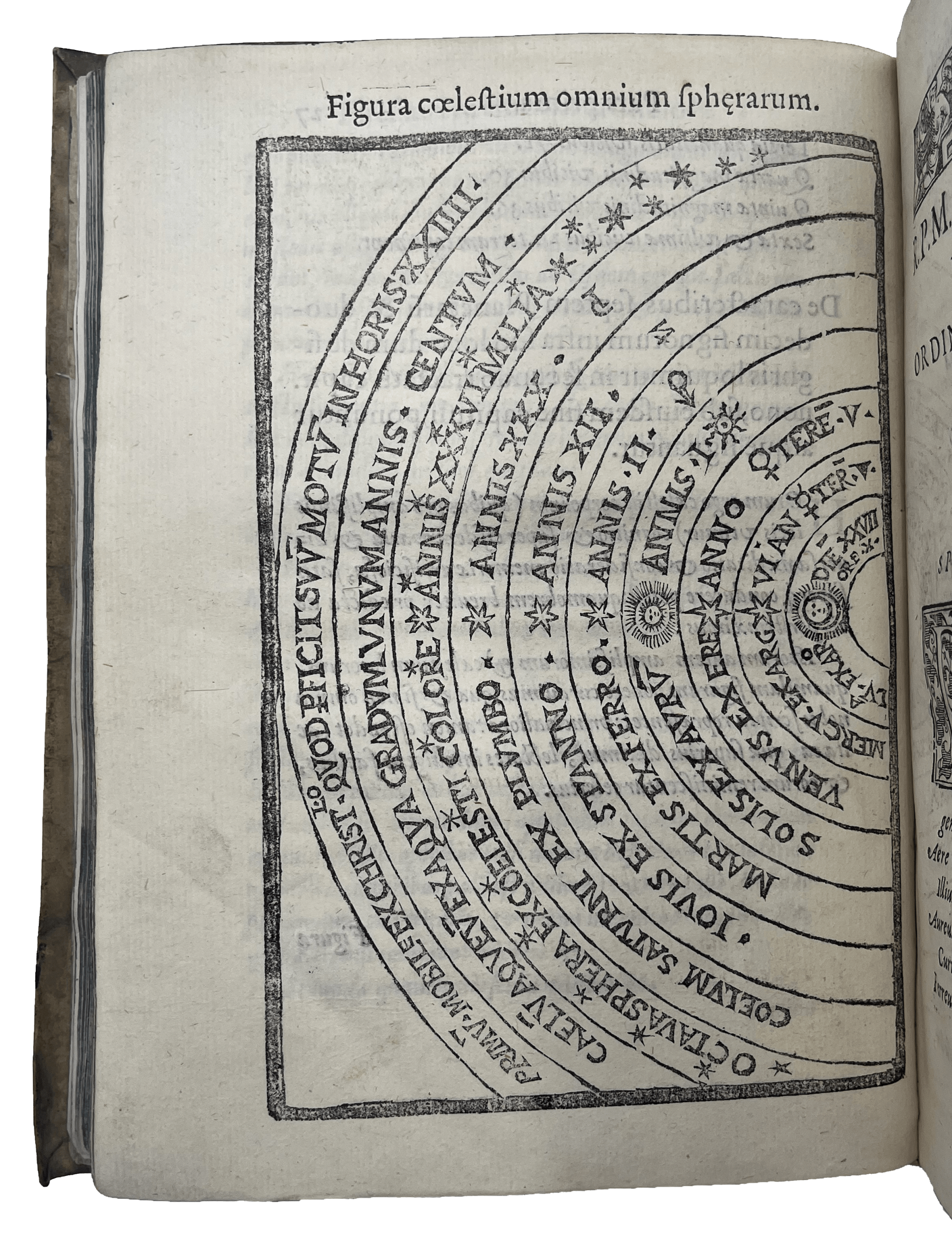
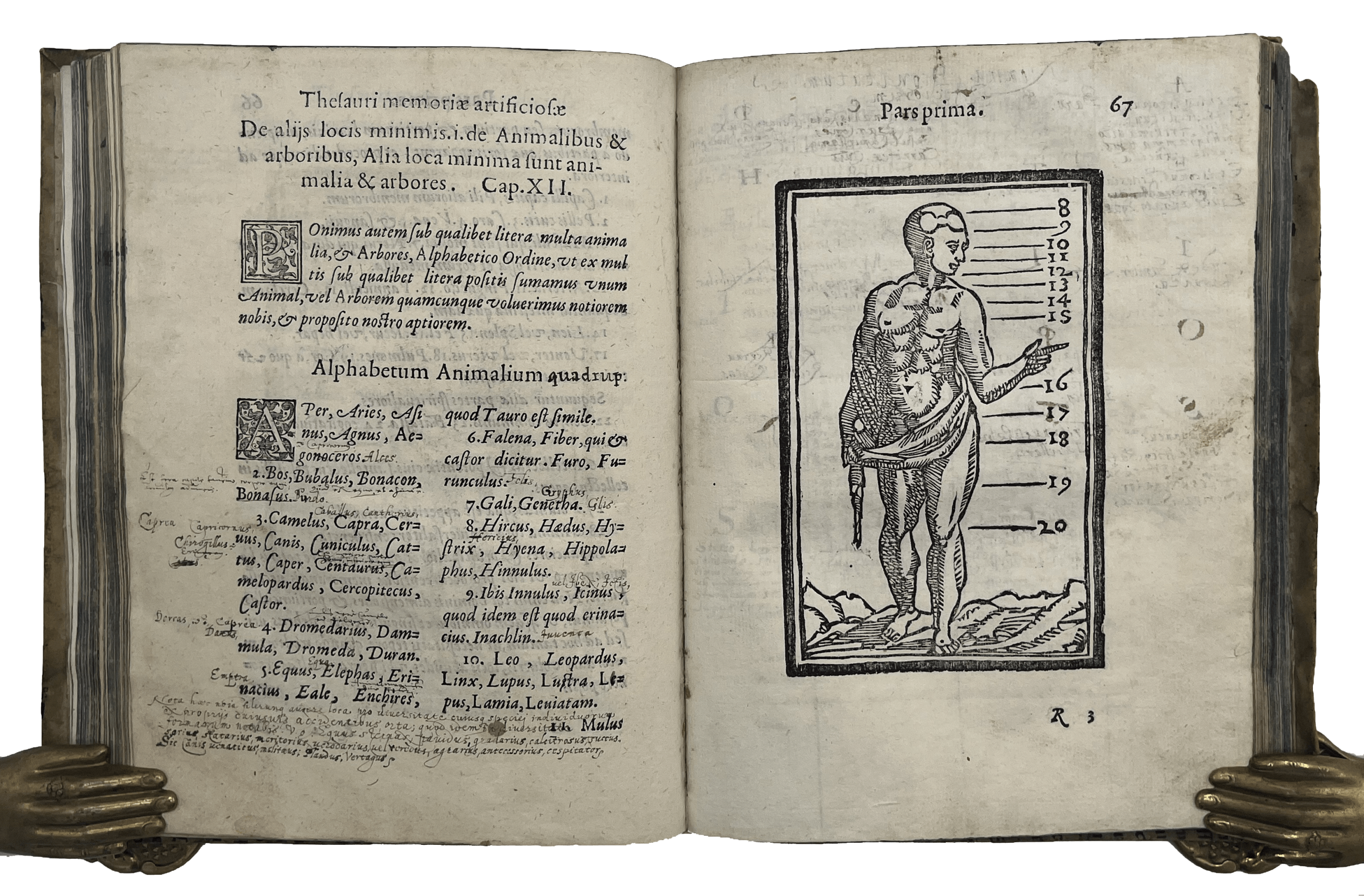
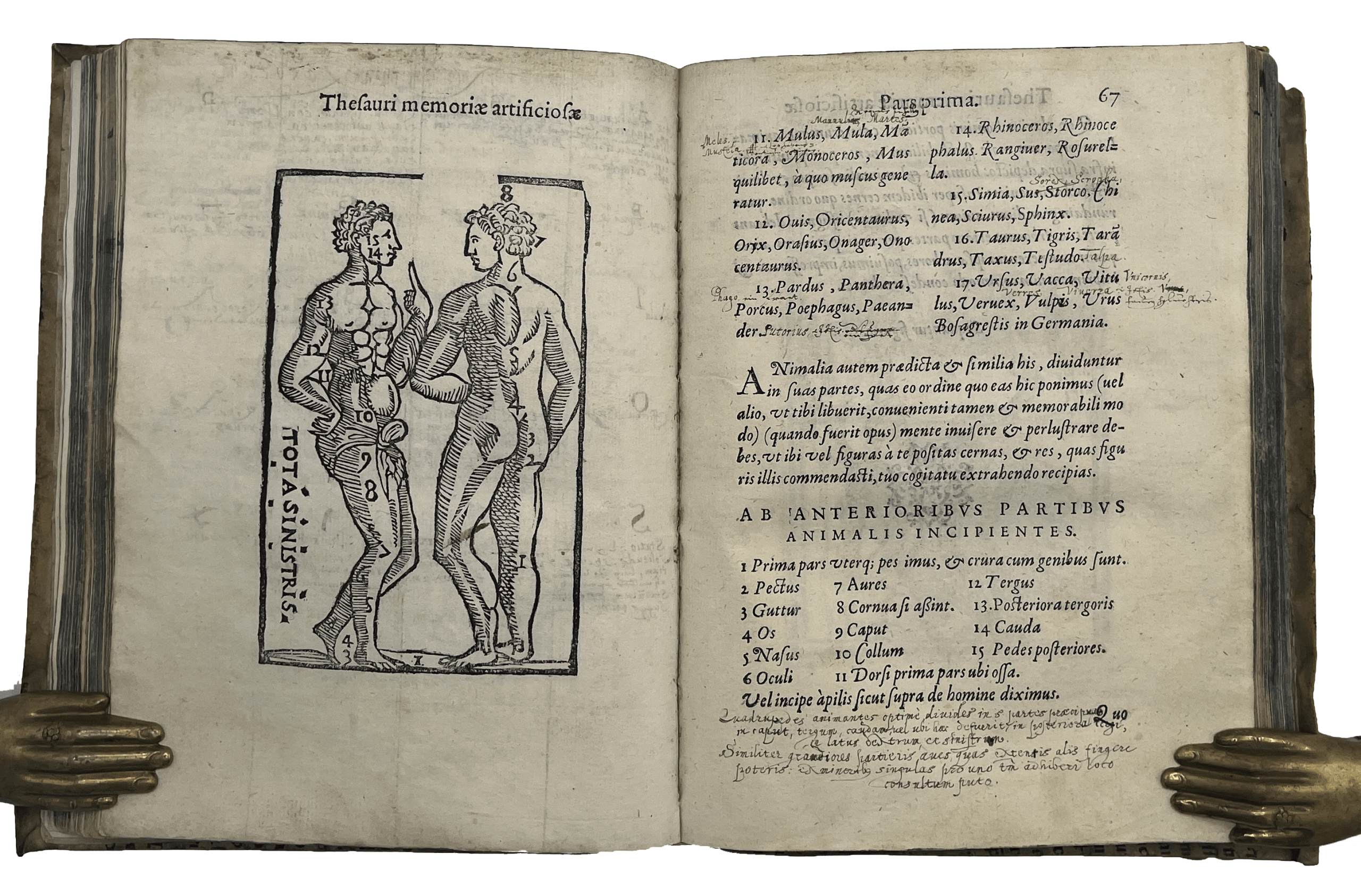
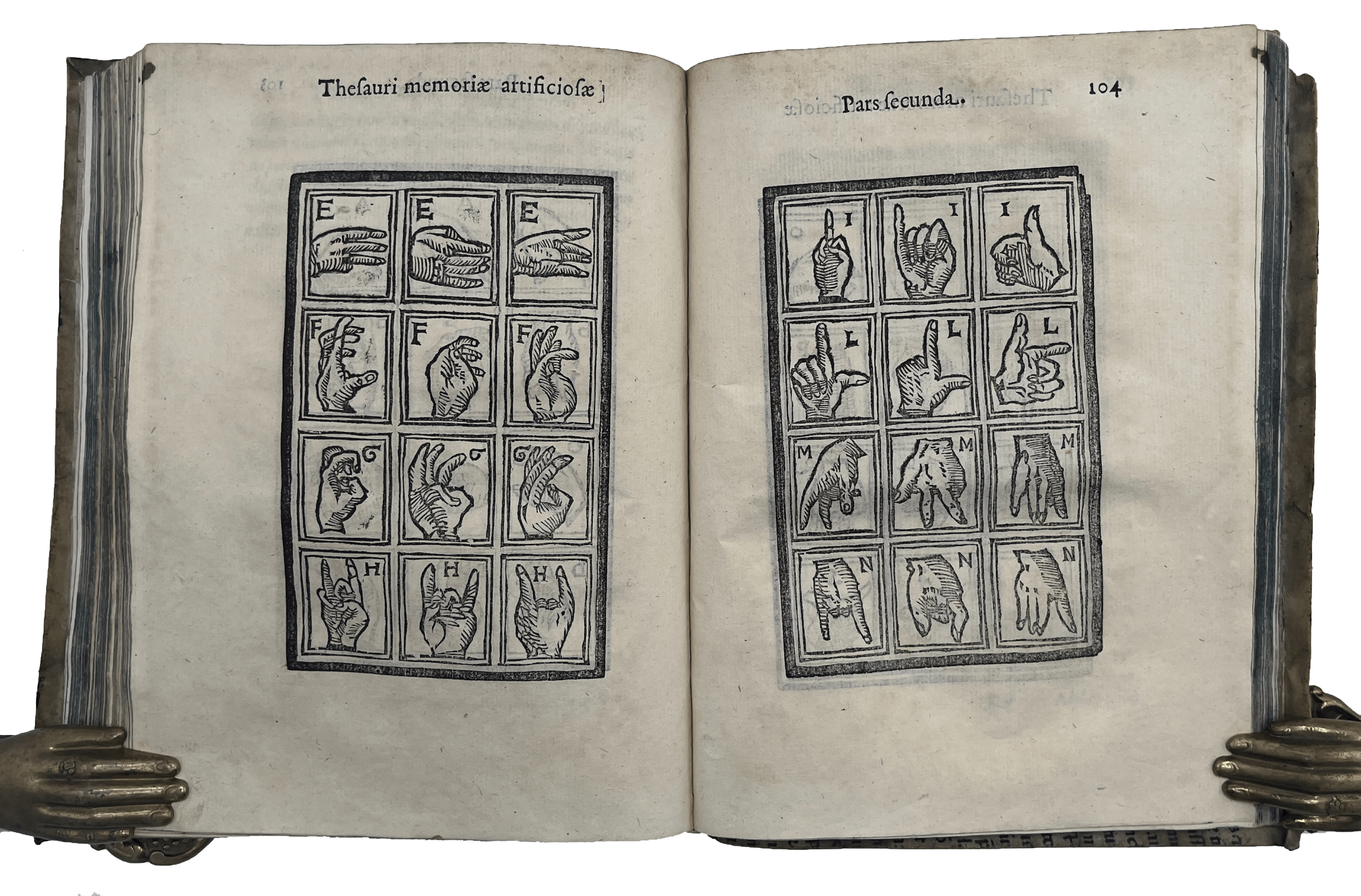
First edition of this fascinating and wonderfully illustrated treatise on memory, utilising visual aids including Heaven, Hell, and the celestial spheres – illustrating a memory system inspired by Dante’s Divine Comedy – anatomical and zoological illustrations, and tables of contemporary objects and rebuses, as well as Persian and Hebrew alphabets, and an alphabetical sign language employing the hands. The author was a Dominican friar from Florence who died the year before this work, apparently his only output, was published. This copy has been extensively annotated by a contemporary, likely monastic reader, including four alphabetical memory lists, of ecclesiastical dignities, place names, body parts and corporeal qualities, and instruments and apparatuses.
The Ars memoriae or art of memory has a history stretching to antiquity; the Greek poet Simonides is supposed to have invented it to memorise poems. Aristotle wrote extensively on memory, which the medieval scholastics understood as necessary for comprehension by the intellect and a useful tool for use in disputations. The Renaissance humanists, similarly, via Cicero and Quintilian, understood memoria as one of the five crucial parts of rhetoric. Rosselli’s work precedes the most famous Renaissance works of memory, by the Italian polymath Giordano Bruno (1548-1600), by several years. Bruno’s earliest book of memory, De umbris idearum, published in 1582, included a Dantesque vision of Hell, the celestial and terrestrial orders, and Heaven. Both Dominicans, Rosselli and Bruno were participating in a tradition of memory treatises associated with the religious order, the earliest being Johannes Romberch’s Congestorium artificiosae memoriae of 1520, which also contained a Dantesque mnemonic system.
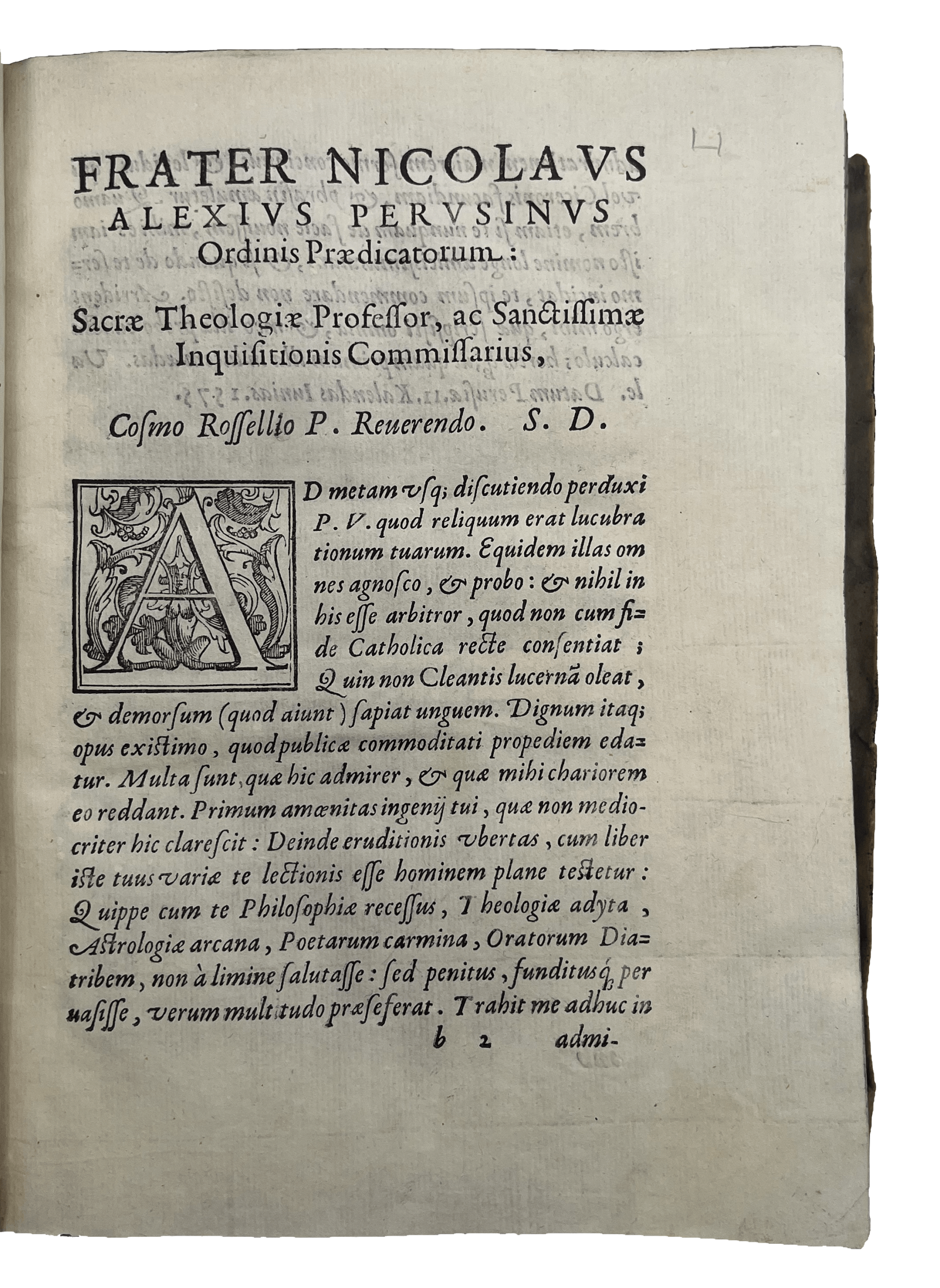
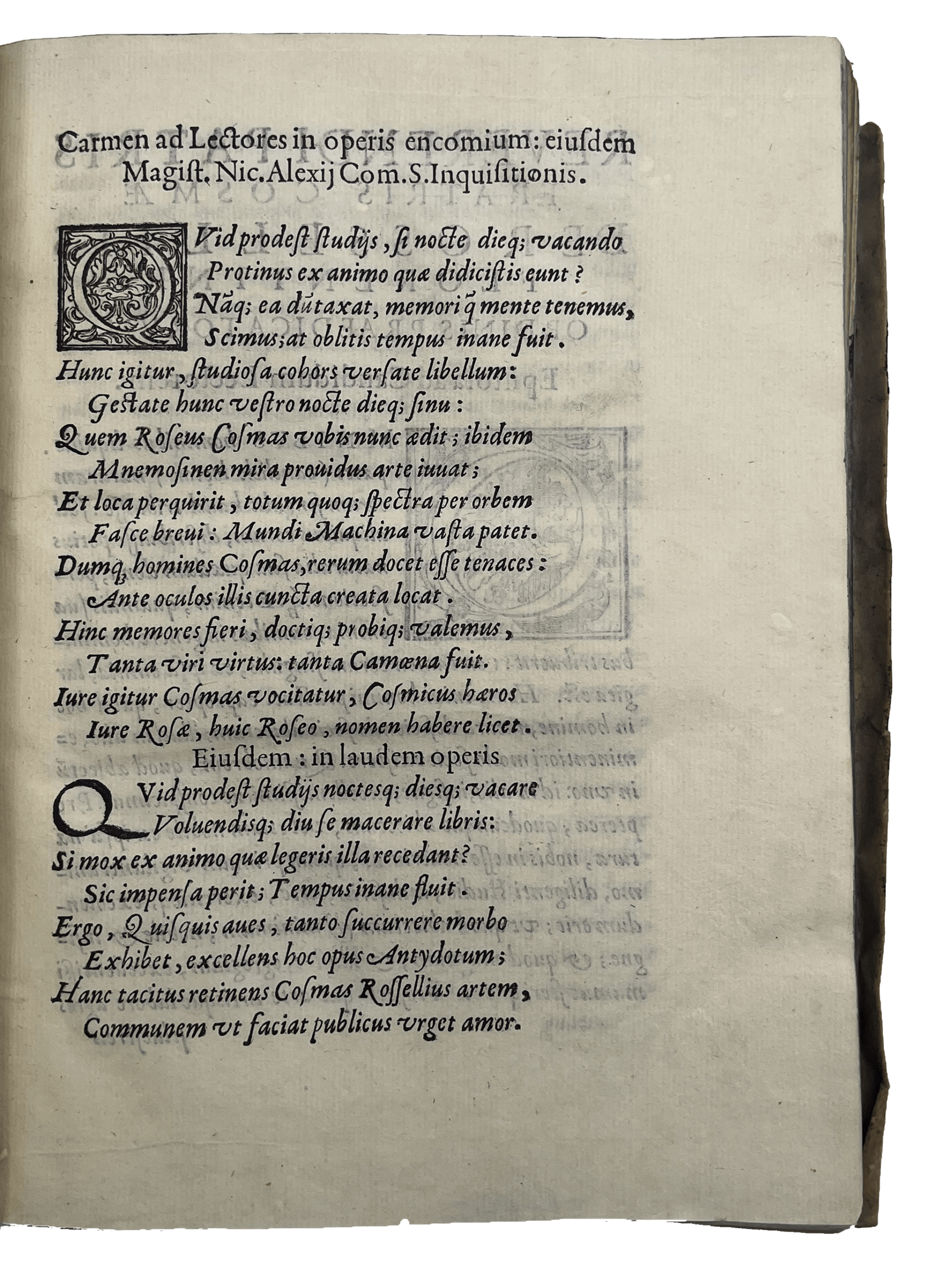
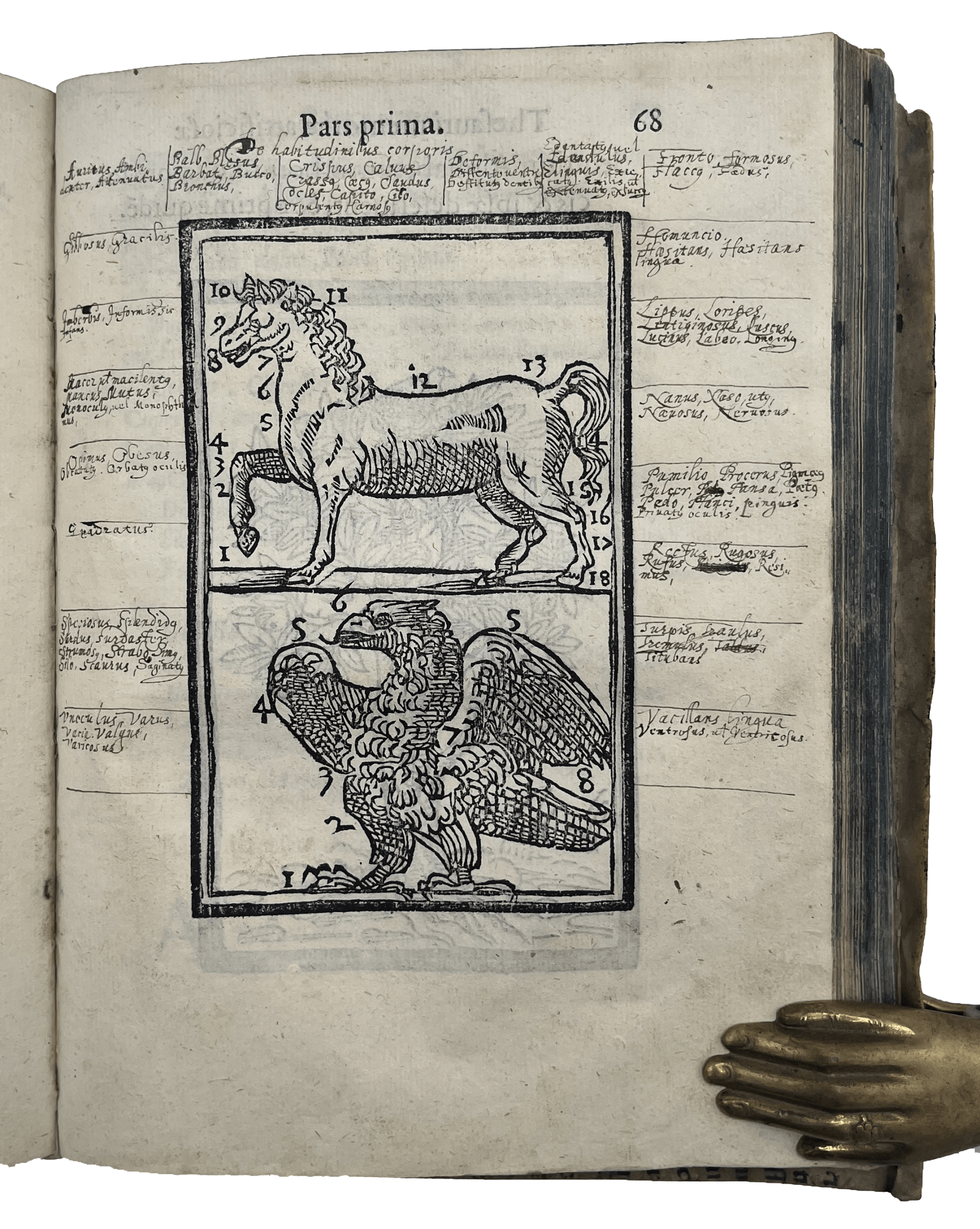
Rosselli begins with a prose description of Hell, accompanied by mnemonic Latin epigrams and quatrains by a fellow Dominican who was also an Inquisitor, ‘giving an impressive air of great orthodoxy to the artificial memory’ (Frances Yates, The Art of Memory (London: 1966), p. 122). Hell is illustrated with a superb woodcut (C4r) showing Lucifer in the centre surrounded by concentric circles of heretics, Jews, idolators, hypocrites, those guilty of the seven deadly sins, all encompassed by the river Styx, various Limbos, and Purgatory. ‘As Rosselli cheerfully observes, ‘the variety of punishments, inflicted in accordance with the diverse nature of the sins, the different situations of the damned, their varying gestures, will much help memory and give many loci’ (Yates, p. 122). This is accompanied by descriptions with woodcut illustrations of the celestial and terrestrial spheres, and of Paradise or the Heavenly Jerusalem, the latter illustrated with a woodcut (K1v, duplicated N3r) showing Cherubim and Seraphim, the Tree and Fountain of Life, the Throne of Christ, Seat of the Virgin, and regions inhabited by children, Hebrew saints, martyrs, virgins, angels, princes, etc. The remainder consists of lists and sub-lists, often alphabetised: planets, the zodiac signs and months of the year; precious stones, gems and minerals derived from Albertus Magnus; animals, including those that live underground, quadrupeds, birds and insects, etc.; trees and plants, including fruit, gum, legumes and common names for herbs; the names of artificers and workmen; and ancient philosophers and thinkers, physicians and poets.
The contemporary reader (or readers) of this copy employed an elegant script possibly in two iterations, one of which is miniscule and barely legible. Evidently returning to the book on several occasions (see different tones of ink), they frequently corrected the woodcuts, headers and content of the book, and cross-referenced its various sections. The annotator using miniscule script extensively glossed Rosselli’s lists of philosophers and gemstones, while the main annotator, in large script, not only added to the author’s lists and annotated the woodcut tables, but also created their own alphabetical lists for memorisation. These are of ecclesiastical benefices; learned positions such as orator, jurisconsultus, etc.; ‘corporeal qualities’ such as gibbosus, obesus, splendidus, etc.; and a fascinating and extensive list of hundreds of words, spreading over several pages, of ‘various instruments,’ apparatuses, buildings, materials, tools, body parts, etc., apparently demonstrating some extremely obscure Latin vocabulary, and including baptisterium, candelabrum, enchiridion, forceps, membrana, refrigeratorium, tormentum, vinum album, xystus (colonnade) and zythus (a kind of liquor).
Young p. 307. EDIT16 CNCE 27839. Adams R803. Brunet IV, 1402. Not in Mortimer.In stock