

PACINUS, Jacobus.
CONTRA FUCHS
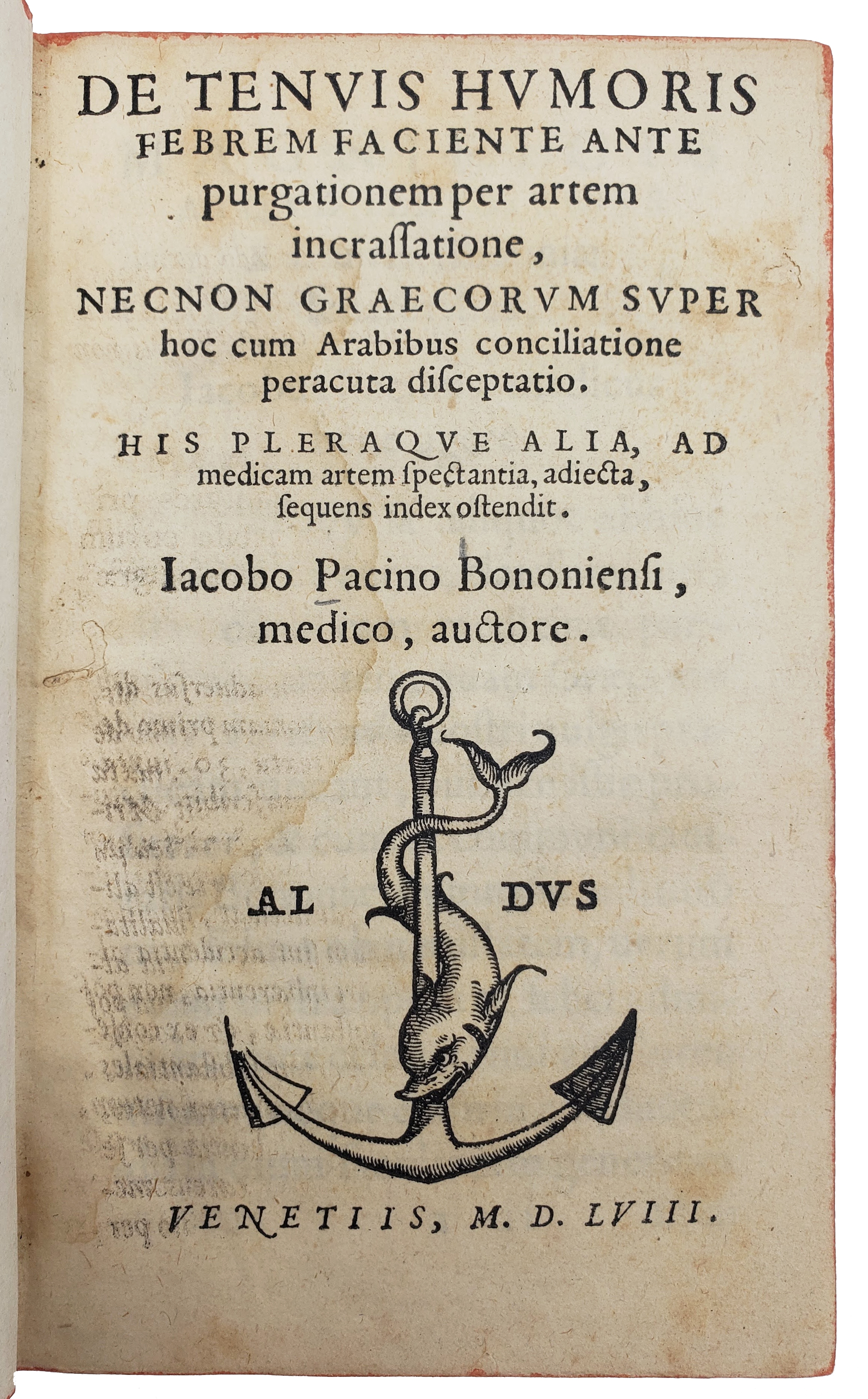
De tenuis humoris febrem.
Venice, Aldus, 1558£1,650.00
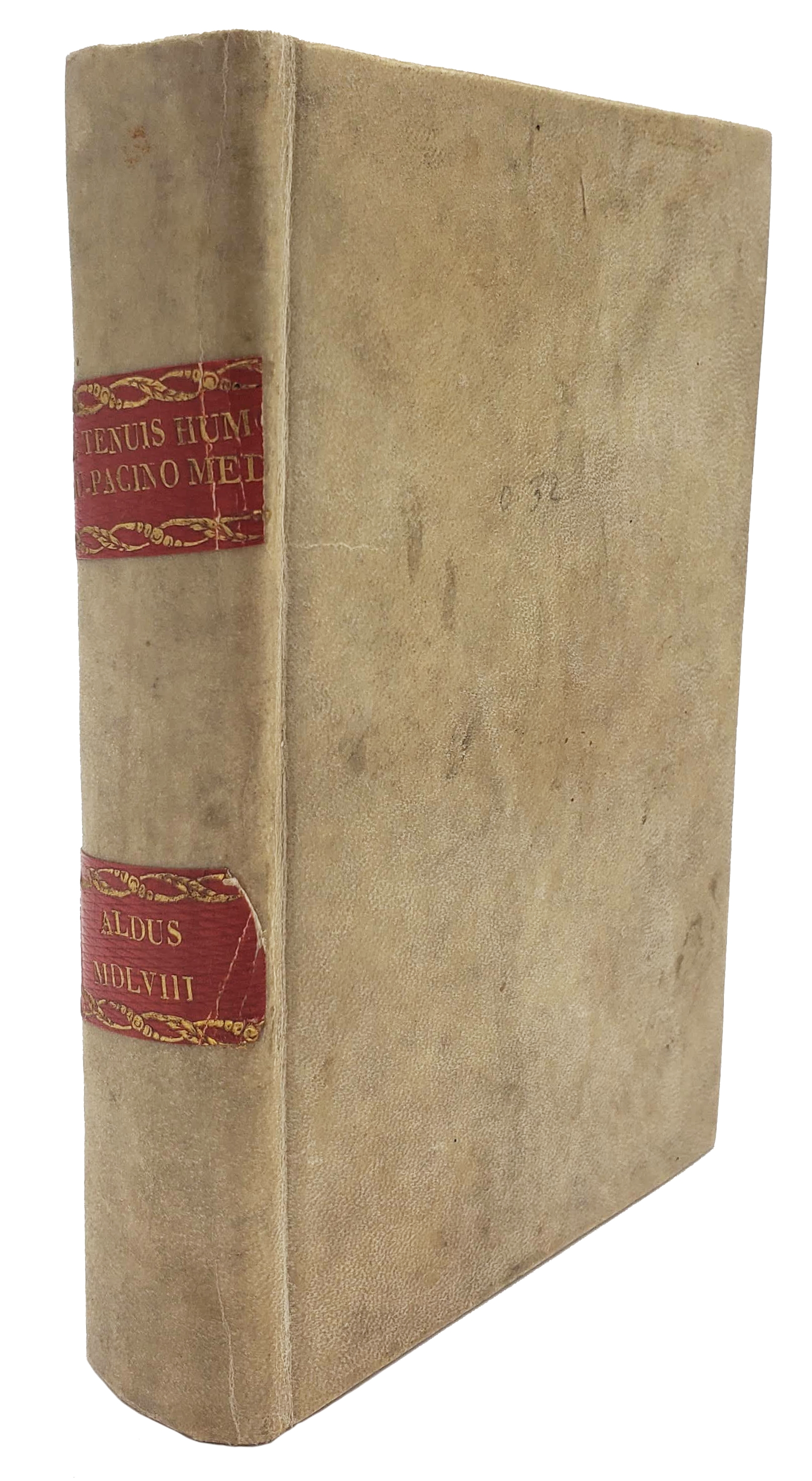
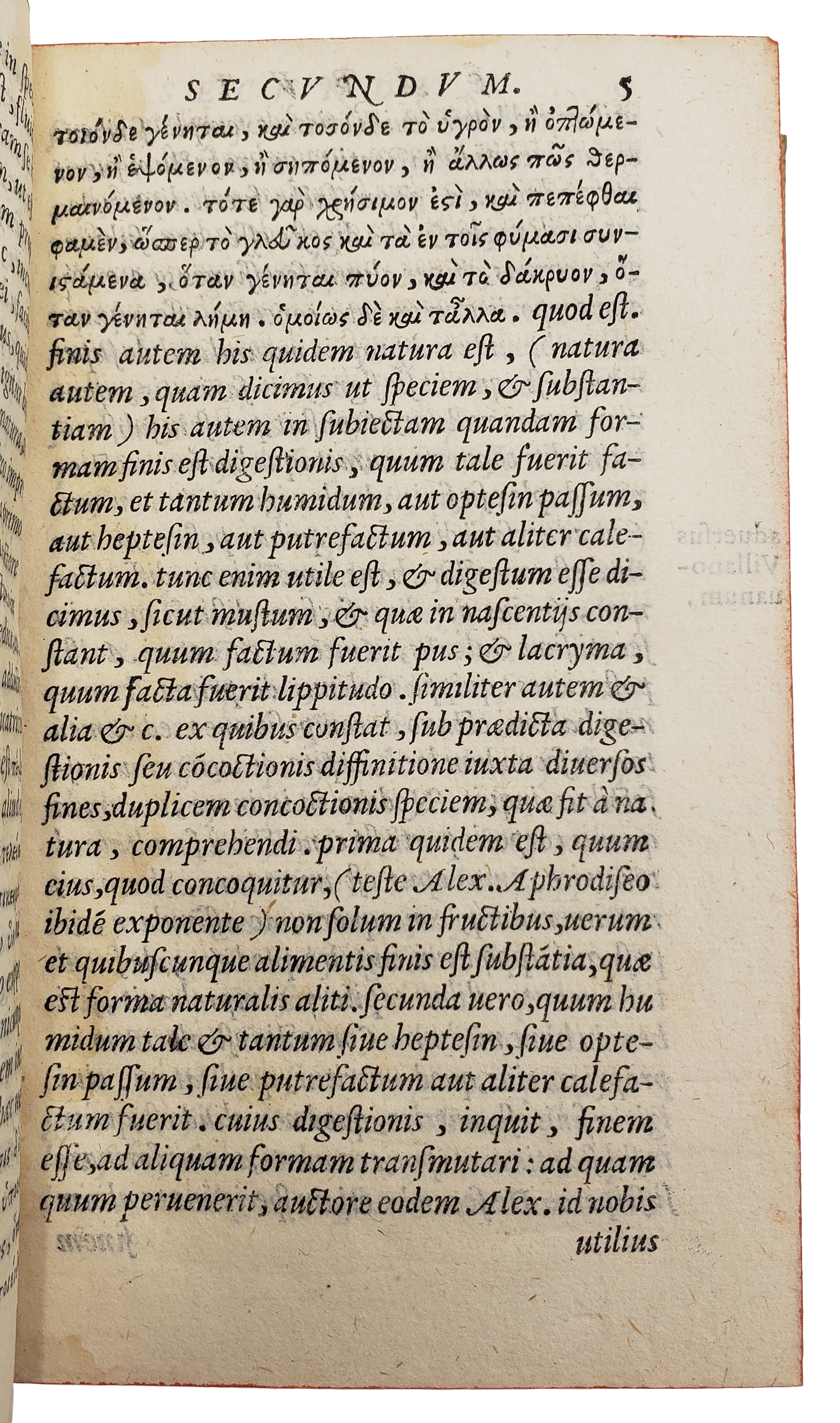
FIRST EDITION. 8vo. ll. (xvi) 267 (i). Italic letter. Woodcut printer’s device to t-p and final verso. One instance of contemp. ms. annotation, underlining with manicule to Greek word to prefatory letter. C19th vellum, red orocco labels to spine, gilt, edges stained red. Inkstamp of T. Kimball Brooker to ffep with his book label laid in. T-p and next with light waterstain to inner half, and to gutter of first quire at head, small wormtrack at gutter of first few ll., not affecting text, light waterstain to lower outer half of final quires. A few ll. a bit browned, edges slightly trimmed with occasional loss from marginal lemmata, one tear without loss, a good copy.
First edition of this polemical work in the debate around ‘thin’ or ‘weak’ humours, said by Pacinus to cause fever before they can be treated through purgation, and which he proposes treating by fattening or thickening of the humours. The title promises to reconcile the differing Greek and Arabian authorities on the matter, while also demolishing the objections of two modern physicians, the German botanist Leonhard Fuchs (1501-66) and the Italian physician Giovanni Manardo (1462-1536), who disagreed with Pacinus’s (and Galen’s) identification of bile and especially yellow bile as a thin or weak humour.
Pacinus, on whom almost nothing appears to have been written and about whom there is very little known, draws on numerous ancient and medieval authorities from the Greek and Arabic traditions, noting where they agree and disagree: Hippocrates, Galen, Aristotle, Paul of Aegina, Aetius of Amida, Alexander of Aphrodisias and Ammonius Lithotomos on the Greek side, and Avicenna and Averroes on the Arabic side, as well as several medieval French and Italian physicians, whom he calls the ‘Latins.’ In the end Pacinus is able to draw Aristotle, Hippocrates, Galen, Paul of Aegina and Avicenna to his side. This mainstream approach was contrary to the Fuchsian method, which was more rigorously humanistic and purist, insisting that the ancient Greek authorities should be read without the subsequent accretions of medieval and Arabic traditions. While Fuchs and the humanists would triumph in the academy, the synthesising approach of Pacino would continue to influence practical medicine for some centuries to come.
A second part contains a discussion of what Hippocrates and Galen described as the ‘containing cause’ of disease, or what the Arabic tradition referred to as the ‘conjunct’ cause, referring to the disease arising or residing in the affected part of the body, meaning it could be cured by evacuation. Once again Fuchs comes under attack in this part for claiming that there was no such thing as the containing or conjunct cause, arguing that when you remove an arrowhead from a limb and the effects continue, clearly the arrowhead was not the conjunct cause; Pacinus counters that the arrowhead remains the conjunct cause even when it is removed from the body. The Italian physician and dietician Matteo Corti is also attacked for suggesting that diseases are caused by the ‘instruments’ of disease, i.e. bodily structures that the disease uses to advance in the body, Pacinus backing Galen’s theory of the containing cause in opposition to Corti, which is ironic given that Corti was a devout Galenist who publicly censured Vesalius for his attacks on Galenic anatomy.
Not in Osler, NLM, Wellcome or Heirs of Hippocrates. USTC 845999. Ren. 173: 2. EDIT 16 CNCE 28041. BM STC It., p. 483. Adams P 6.