
HARVEY, Gideon
WITH MATERIAL ON WINES
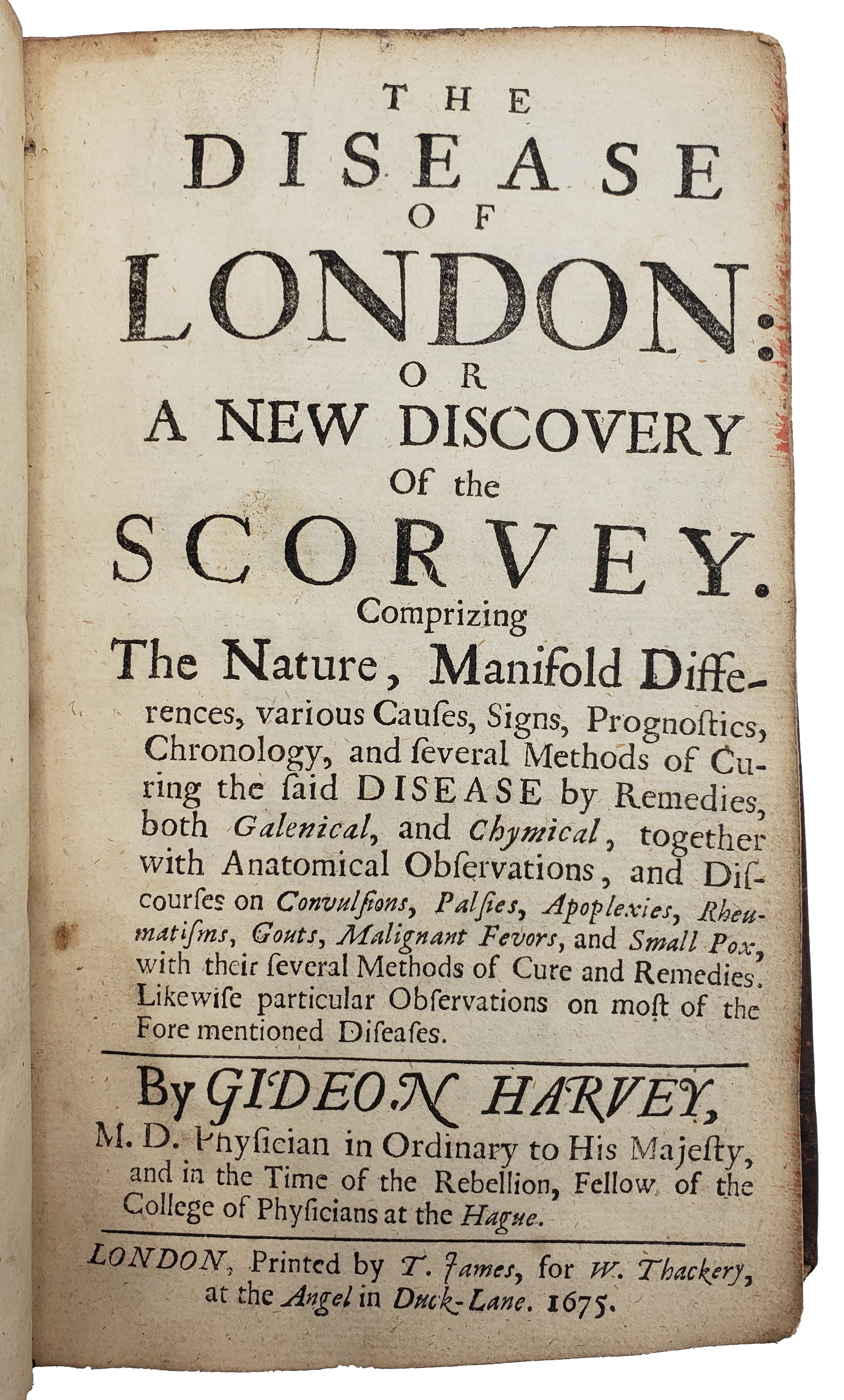
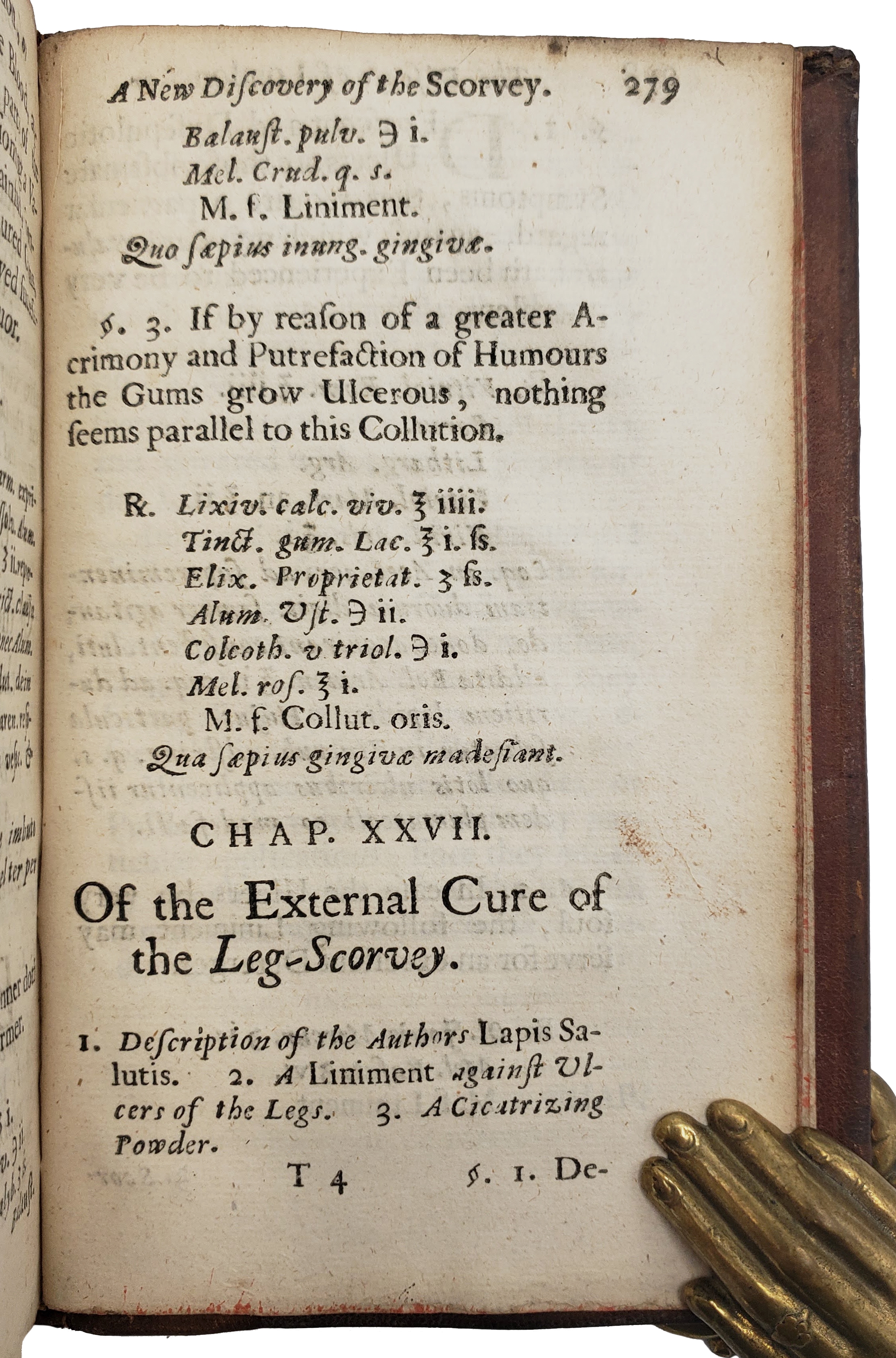
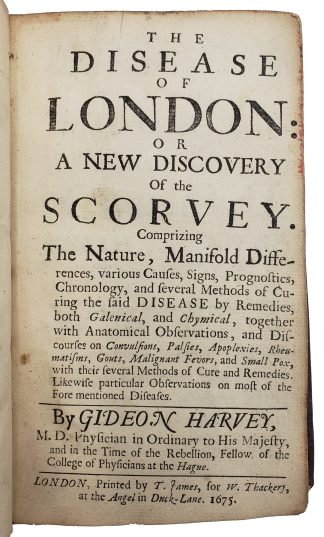
The Disease of London: or a New Discovery of the Scorvey.
London, Printed by T. James, for W. Thackery, 1675.£2,850.00
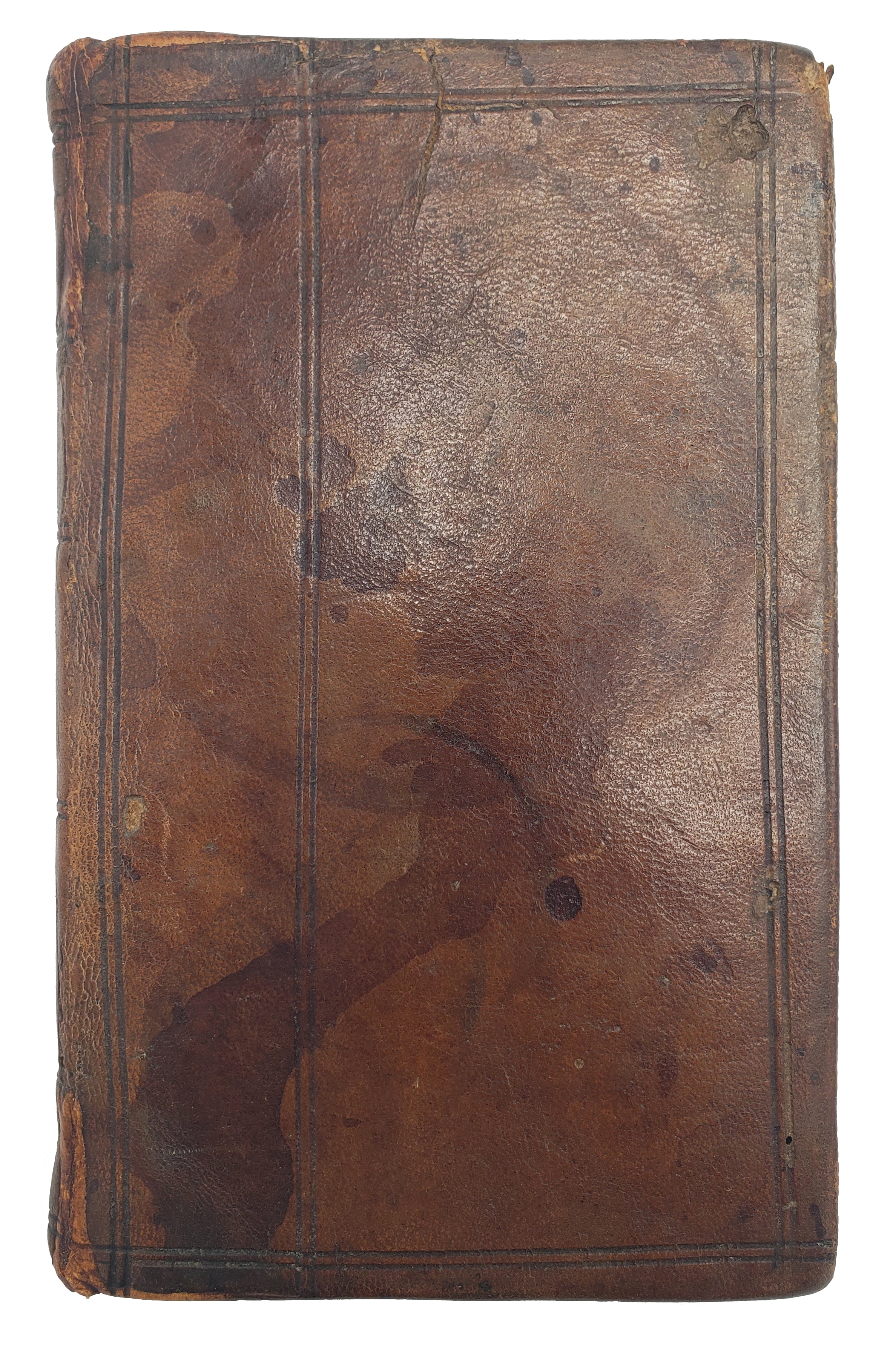
FIRST EDITION. 8vo. pp. [ii] (xiv) 296. Roman letter. Typographical headpieces. Modern bookplate pasted to fly, late C18 or early C19 autograph, ‘M. Humphries’ above. Contemp. sheep, fillet borders in blind, rebacked, spine remounted, a little stained. Slight yellowing, the odd light spot or smudge, mostly marginal, a very good copy.
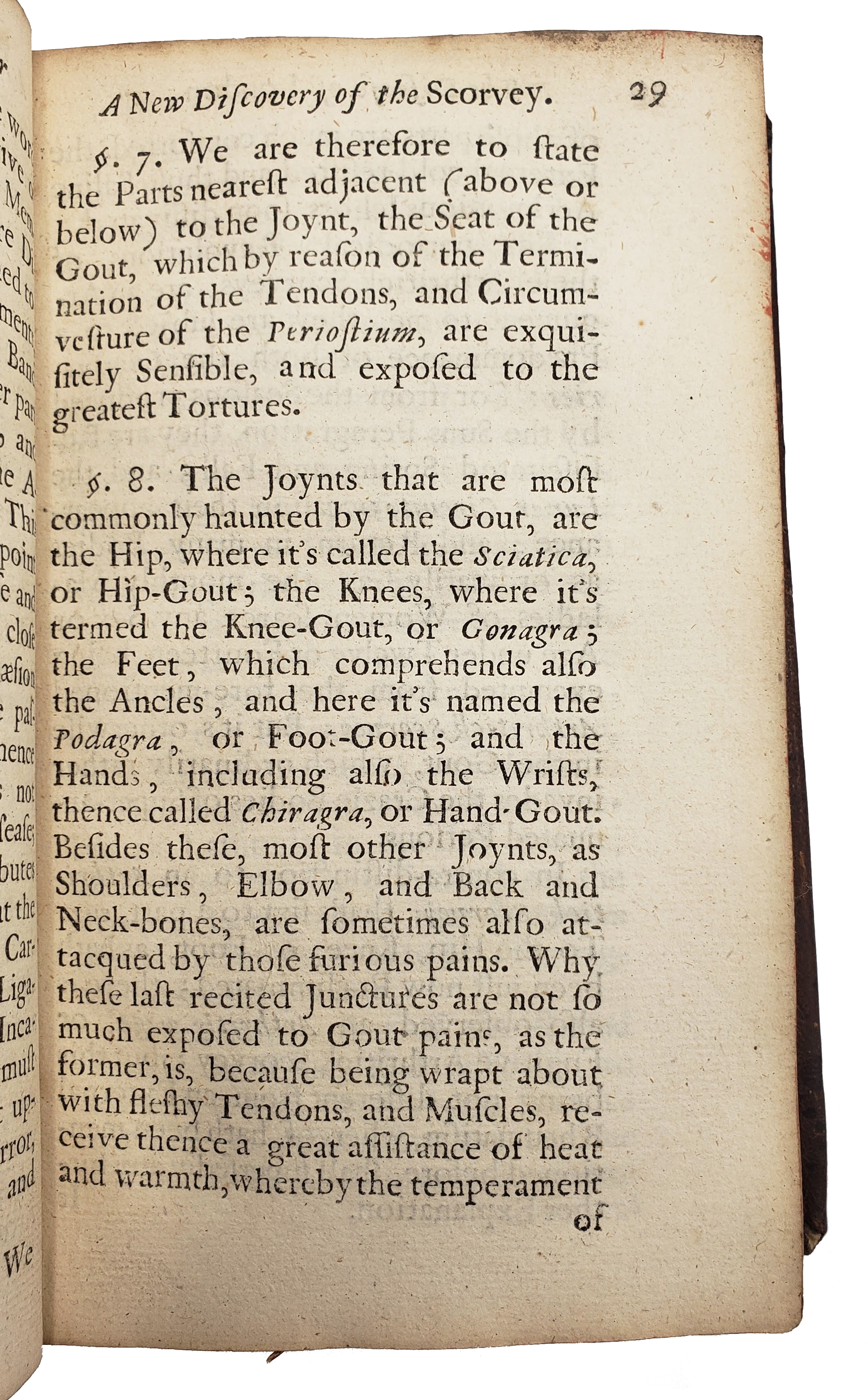
First edition of the irascible Anglo-Dutch physician Gideon Harvey’s (c.1640-1700) treatment of scurvy, which he describes as an endemic disease, probably only about 200 years old, largely arising from bad air or climate. The ancient Greeks do not seem to have suffered from it because they lived in a good climate and led an active, warlike lifestyle, which banished melancholy and other ‘dull passions.’ He describes its chief symptoms, which are its attacks on the gums and teeth and the leg joints. There is some interesting experimental anatomy, in which Harvey attempts to unite Galenic medicine with chemical or ‘spagyric’ medicine. Harvey’s basic proposition is that mouth-scurvy is caused by stomach acid carried to the mouth in the ‘lymphatic channels.’ To prove the existence of these channels, he observes the dissection of the stomach of a dog, which was ‘fed with salt meat intermixed with Sublimate Corrosive, and thereupon most thirstily Lapping a great quantity of Water, wherein Pease had been boyled, [was] immediately strangled’ (p. 55). The idea behind curing mouth-scurvy is therefore to get the stomach to produce more alkaline saliva, which will ameliorate the effects of scurvy in the mouth.
Much of the treatise is given over to the nature of the blood, whether it is acid or alkali. This gives way to the discussion of wines, which is an attack on the Oxonian physician Dr Thomas Willis’s (1621-75) recent treatment of scurvy, in which he likened the acidic qualities of blood to those of wine or vinegar, which Harvey refutes. There is a section in which he describes the proper care and storage of wine, as advocated by wine-coopers, to avoid its fretting or turning rancid. The remainder of the work considers the treatment of scurvy, including herbal recipes for purgatives, laxatives, powders, pills, syrups, cordials, etc. There is final short chapter on the small-pox, in which Harvey notes its similarities to scurvy and identifies it as a disease endemic to northern climates.
‘Though Harvey was a successful clinician, physician to Charles II and William III, as well as city physician of London, he was a medical outsider. He was a severe critic and scourge to his contemporaries, whom he designated ‘dung-doctors’ because of some of their clinical methods … He wrote almost endlessly on philosophy, diseases, cures, real or imagined quackery and charlatanry, with many of his books passing through two or three editions’ (Heirs of Hippocrates).
ESTC R15315. Heirs of Hippocrates 414. Not in Osler, Wellcome or NLM. Not in Oberlé, Simon, Bitting or Vicaire.