GERMANUS, Domenicus.
ARABIC-ITALIAN GRAMMAR AND DICTIONARY


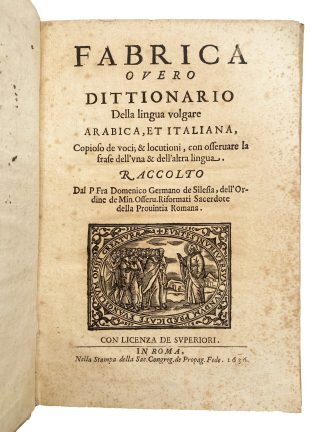
Fabrica overo Dittionario della lingua volgare Arabica, et Italiana.
Rome, Nella Stampa della Sac. Congreg. de Propag. Fide, 1636£2,250.00
FIRST EDITION. 4to. pp. [10], 102. Roman letter, with Arabic. Woodcut vignette to title. Initial and final ll. a trifle softened, title a little soiled at margins, minor repair to lower or outer margin of first gathering, couple of light ink smudges. A good copy in C19 quarter calf over marbled boards, marbled eps, bookplate of Junta de Protección del Tesoro Artístico Nacional, coll. T’Serclaes at the Biblioteca Nacional to front pastedown, slightly later ms ‘Missionis Aegypti Reformatorum’ to title, C19/C20 ms cryptographic cyphers to rear fep.
First edition of the first Arabic-Italian grammar and phrasebook, produced by the Propaganda Fide press in Rome – formerly in the library of the Franciscan mission in Egypt. ‘In 1630, Friar Paolo da Lodi was nominated the first prefectus missionis Aegypti. He […] took up residence in the Venetian embassy and succeeded in setting up residence for the friars in a house just outside the diplomatic compound. […] The friary of Cairo became the seat of the prefect, and at the end of the century, an institute for the study of Oriental languages was opened there. In 1632 the Congregation de Propaganda Fide established a Franciscan prefecture in Ethiopia […]. Upon their arrival in Egypt, they approached the
Coptic patriarchate and visited the monasteries of St Antony and St Macarius to perfect their
knowledge of Arabic’ (Van Zeelst).
The Polish Franciscan Domenicus Germanus (1588-1670) was a missionary and teacher of Arabic in Rome, at the Monastery of San Pietro in Montorio. ‘Fabrica’ was intended as an introduction to colloquial Arabic in relation to Italian, for Germanus’ own students and future missionaries in the Middle East. He begins by stating that ‘those who wish to learn a foreign language must needs become children again’; in particular, for Arabic, it is important to pronounce it correctly, due to the numerous difficult letters. The work begins from the basics – letter forms, pronunciation, diacritics – followed by the Holy Father, the Commandments, Salve Regina, the Confession, the Professio Fidei, in Arabic and Latin (not the ‘Protestant’ Italian here!). The second part discusses nouns, participles, pronouns, and
verbs, adjusting the three Arabic grammatical cases to the six Latin ones, with examples involving a man named Zaid, as found in medieval Arabic grammars such as Sibawayh’s. In so doing, Germanus introduces everyday vocabulary which the students could assimilate whilst learning the grammar. ‘The “vernacular Arabic” was considered by these authors as a spoken and written language. In order to explain the relationship between the two forms of Arabic to their students, they also referred to the parallel between Latin and Italian. This ‘vernacular Arabic’ seems to be a hybrid language, mixing up the characteristics of standard Arabic and specificities of the Near Eastern dialects: a form of the language known as ‘middle Arabic’, widely used in the Near East until the Nahḍa (Arabic awakening)’ (Girard, pp.205-6). Germanus’ colloquial was based on the Levantine. Whilst it preserves here some
of the classical grammar (e.g., ‘lan’ to negate the future), it displays constructions and vocabulary, such as ‘lamma’ for ‘when’ and ‘b’ad mā’ for ‘b’ad ‘an’, which are more frequent in Levantine. A final section explains how to read Arabic when diacritics (short vowels) are absent, which will happen nearly most of the time. A most interesting, important work.
Formerly in the collection of Juan Pérez de Guzmán y Boza, Duque de T’Serclaes (1852-1934), Spanish historian, politician, and bibliophile. He amassed one of the most important private libraries in Spain, dispersed after his death. After the Civil War, the part donated by the family to the National Library of Spain was reclaimed and later dispersed (BNE).
USTC 4014351; Fumagalli p.354, Brunet II, 155. A. Girard, ‘Teaching and Learning Arabic in Early Modern Rome\', in The Teaching and Learning of Arabic in Early Modern Europe, ed. J. Loop et al. (2017), pp.189-212. L. Van Zeelst, ‘Franciscans in Egypt’, The Coptic Encyclopedia, vol.IV (1991)