
FRANCQUART, Jacques

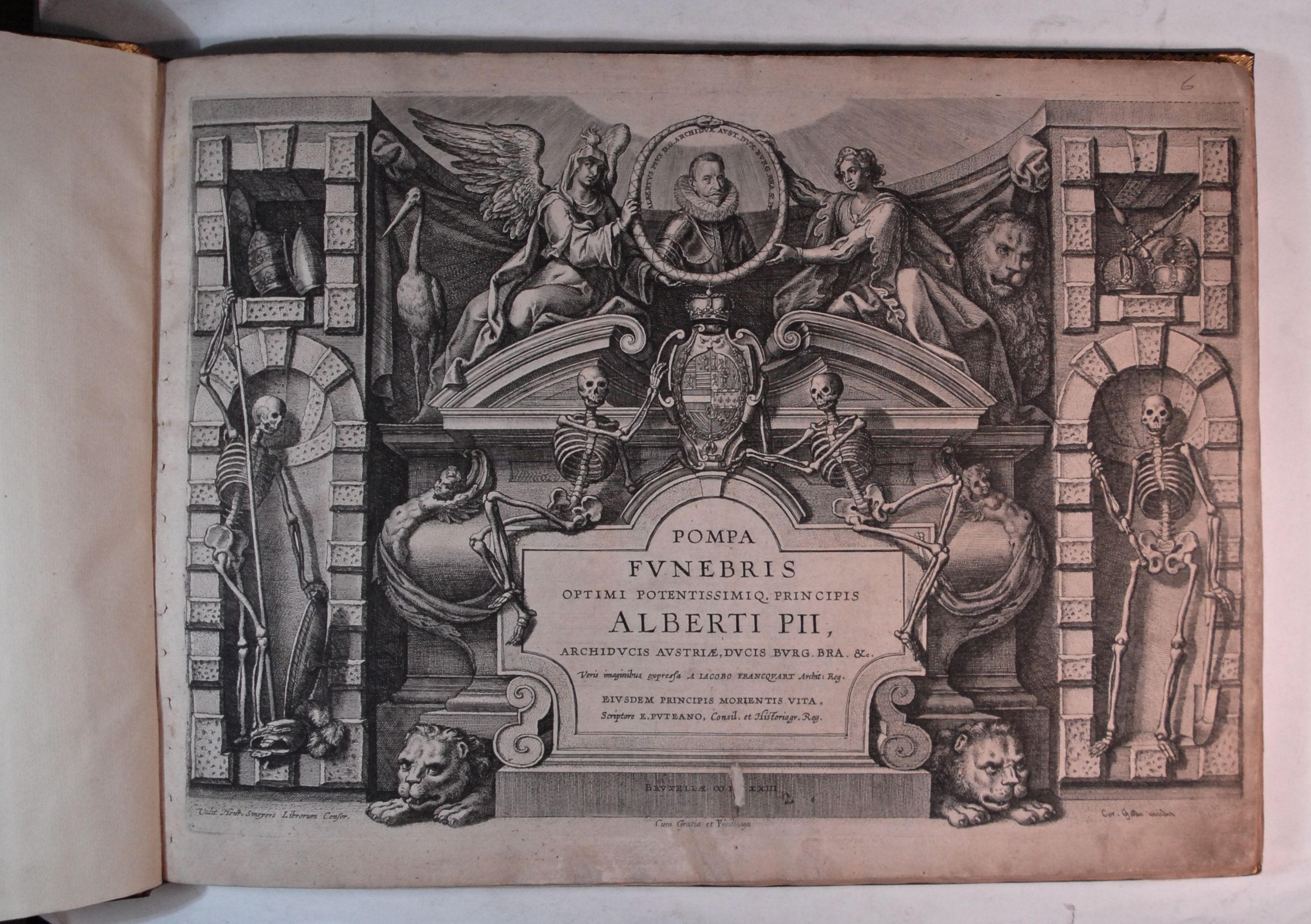

Pompa funebris optimi potentissimiq[ue] principis Alberti Pii, Archiducis Austriae, ducis Burg. Bra. &c.
Brussels, Prostant apud Joannem Mommartium, [1623]£4,750.00
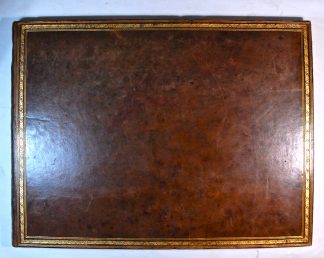
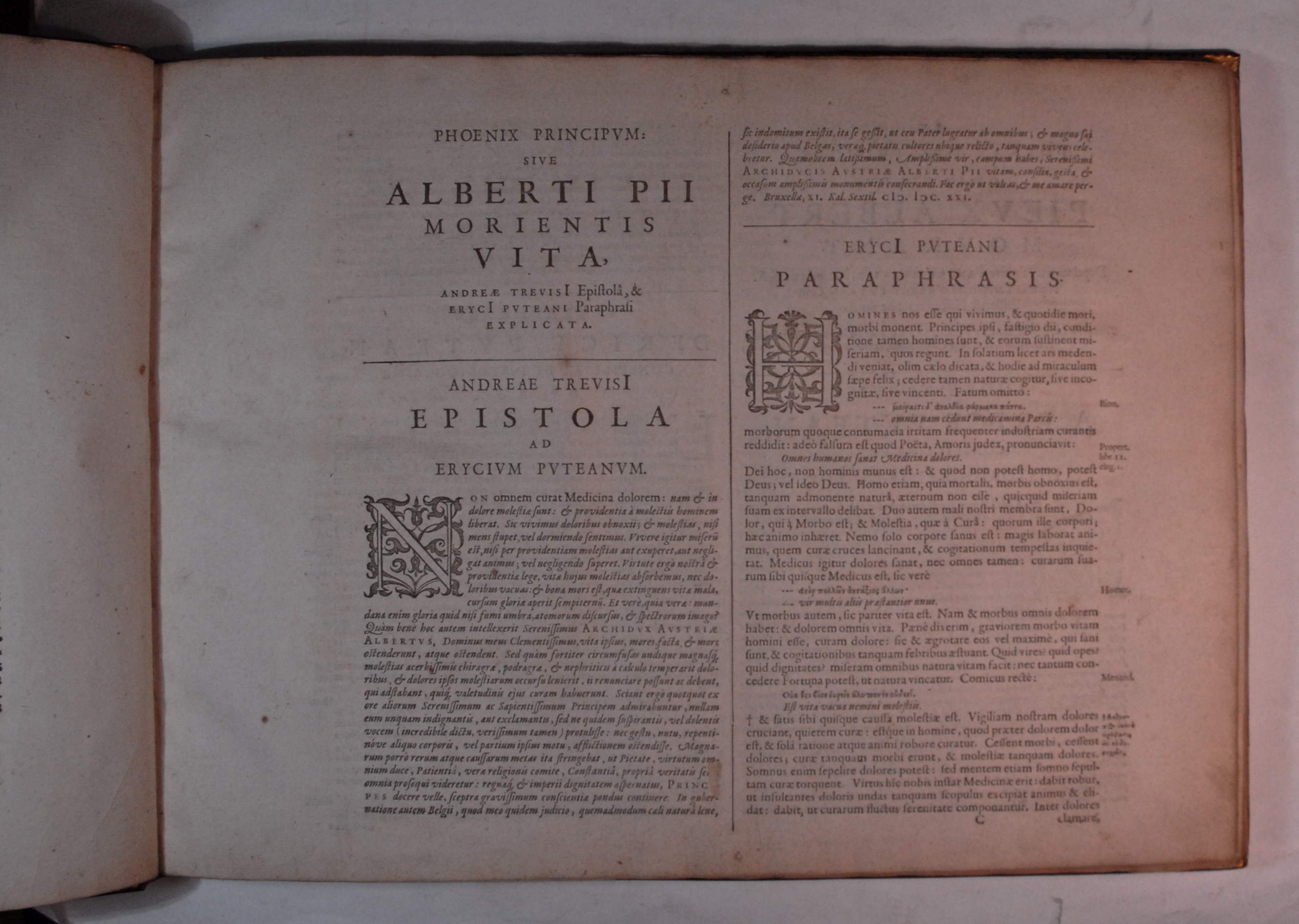
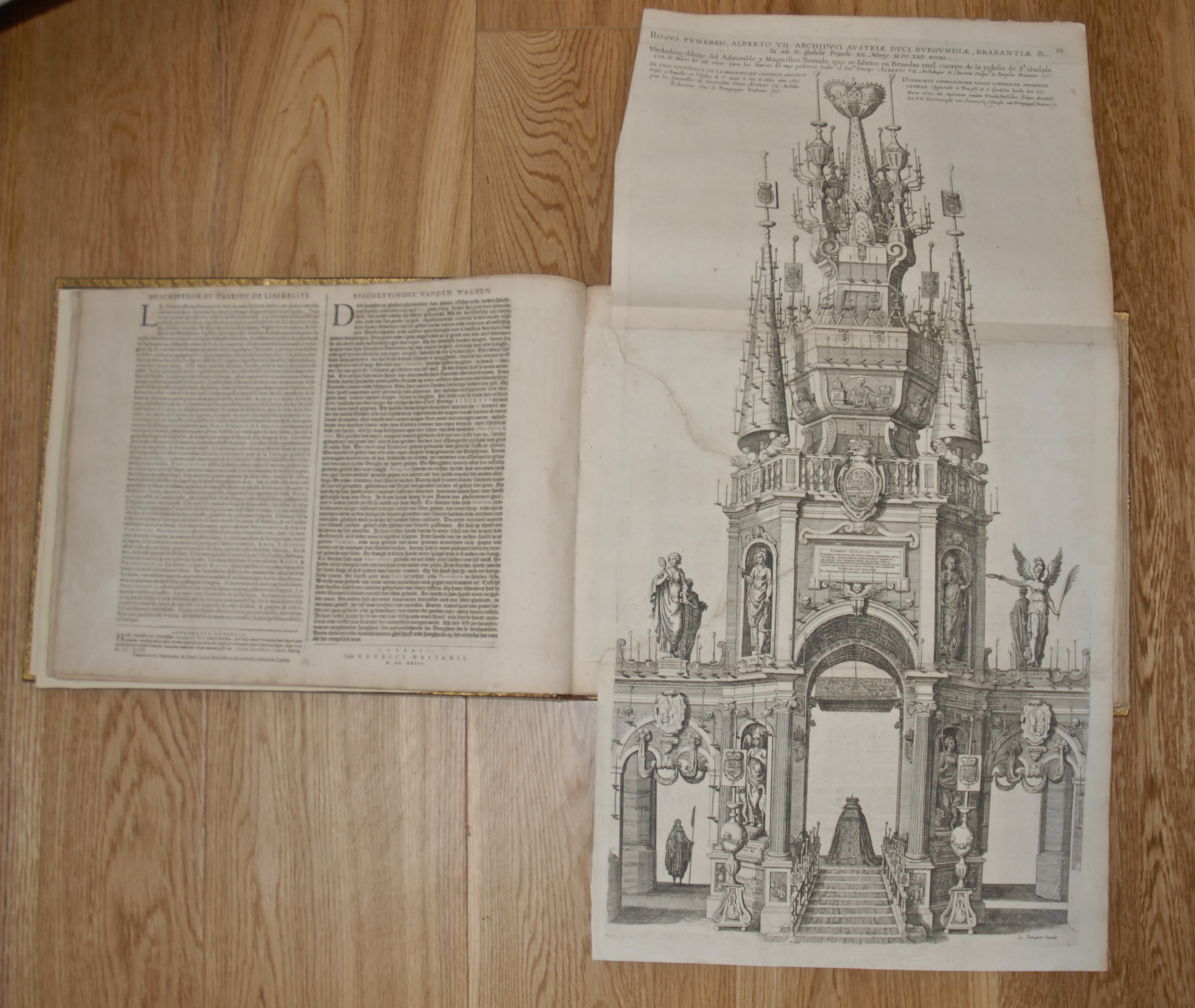
Oblong folio. Engraved title page, 12 unnumbered ll. A-M1, text in double column in Latin, Spanish, French and Dutch, 64 eng. plates, of which two are folding, by Cornelis Galle after Francquart. Roman, Italic and Gothic letter. Very fine engraved architectural t-p (small flaw at foot), with portrait of Albert VII held aloft by angels, stork and lion at sides, skeletons with papal regalia to the left and royal regalia to the right, two skeletons holding Albert’s arms, three part folding plate of the funeral monument of the Archduke, three part plate of the funeral chariot viewed in profile and from behind, numbered a, b and c., the remaining full page plates depict the funeral procession and its regalia, engraved bookplate of Silvio Zipoli on pastedown. Light age yellowing, minor marginal spotting, the odd thumb mark, engraved title fractionally dusty, folding plate III moved to the front, plate LIII moved in its place, closed tears on both folding plates expertly repaired with no loss, occasion tiny marginal tear restored, one plate fractionally trimmed at fore-edge, printed correction slip to leaf H, stab holes from original binding visible at gutter. A very good copy, with excellent strong impressions of the plates, in late C19 speckled calf gilt, covers bordered with double gilt rules and gilt roll, spines richly gilt in compartments, red morocco label gilt, inner dentelles gilt, extremities a little worn.
First edition of this superb suite of beautiful and very finely engraved plates commemorating, in extraordinary detail, the funeral of Albert VII, engraved after the designs of Jaques Francquart by Cornelis Galle, with a description of the occasion by Puteanus; one of the most eminent works of the golden age of Flemish copperplate engraving. Jacques Francquart (1582/3–1651) was a Flemish painter, court architect, and an outstanding copper plate engraver, born at Antwerp. He traveled to study in Italy and was apprenticed to Rubens on his return. In 1613 he obtained the position of court painter to the Archduke Albert. He designed the Temple des Augustins which stood on Place de Broukere in Brussels. The Archduke Albert’s highly cosmopolitan court became a flourishing centre of the arts, a showcase for other courts throughout Europe. The archduke, with his support of artists such as Rubens, did much to contribute towards the creation and spread of the style later known as ‘Flemish Baroque’. The Twelve Year Truce (1609-1621), in the civil war in the Netherlands, brought the necessary peace for a political, economic and in particular cultural revival. Albert surrounded himself with artists, such as Peter Paul Rubens, Jan Brueghel, Wenzel Coebergher, Jacques Franckaert, the composer Peter Philips and the South-Netherlandish humanist Justus Lipsius. Francquart designed the funeral chariot and its engraving in this work is nearly a meter long. The plates depicts of more than 700 members of the funeral cortege. It is also innovative in that he created a table of ‘hatching’ to represent heraldic colours, which is the earliest hatching system in heraldry. The work is particularly interesting in giving a detailed snapshot of the composition of the court of Albert at his death. “When Albert set out for the Netherlands in 1595, his court was almost entirely Spanish. The two mayordomos, all the gentlemen of the bedchamber and every chaplain but one were from the peninsula. .. The transformation was almost complete by the time of his death. None of the mayordomos who marched in the funeral procession was Spanish. One was a Burgundian; the other five were titled noblemen from the Netherlands. There was only one Spaniard among the eight gentlemen of the bedchamber who bore the coffin with Albert’s remains. .. On all these levels, the local nobility had taken over.” Luc Duerloo. ‘Dynasty and Piety: Archduke Albert (1598-1621)’ A very good copy of this monumental work.
Landwehr, Splendid Ceremonies, 69. Brunet II 1379. Watanabe-O\\\\\\\\\\\\\\\'Kelly & Simon 2707.In stock