
CAROCHI, Horacio.
AZTEC GRAMMAR
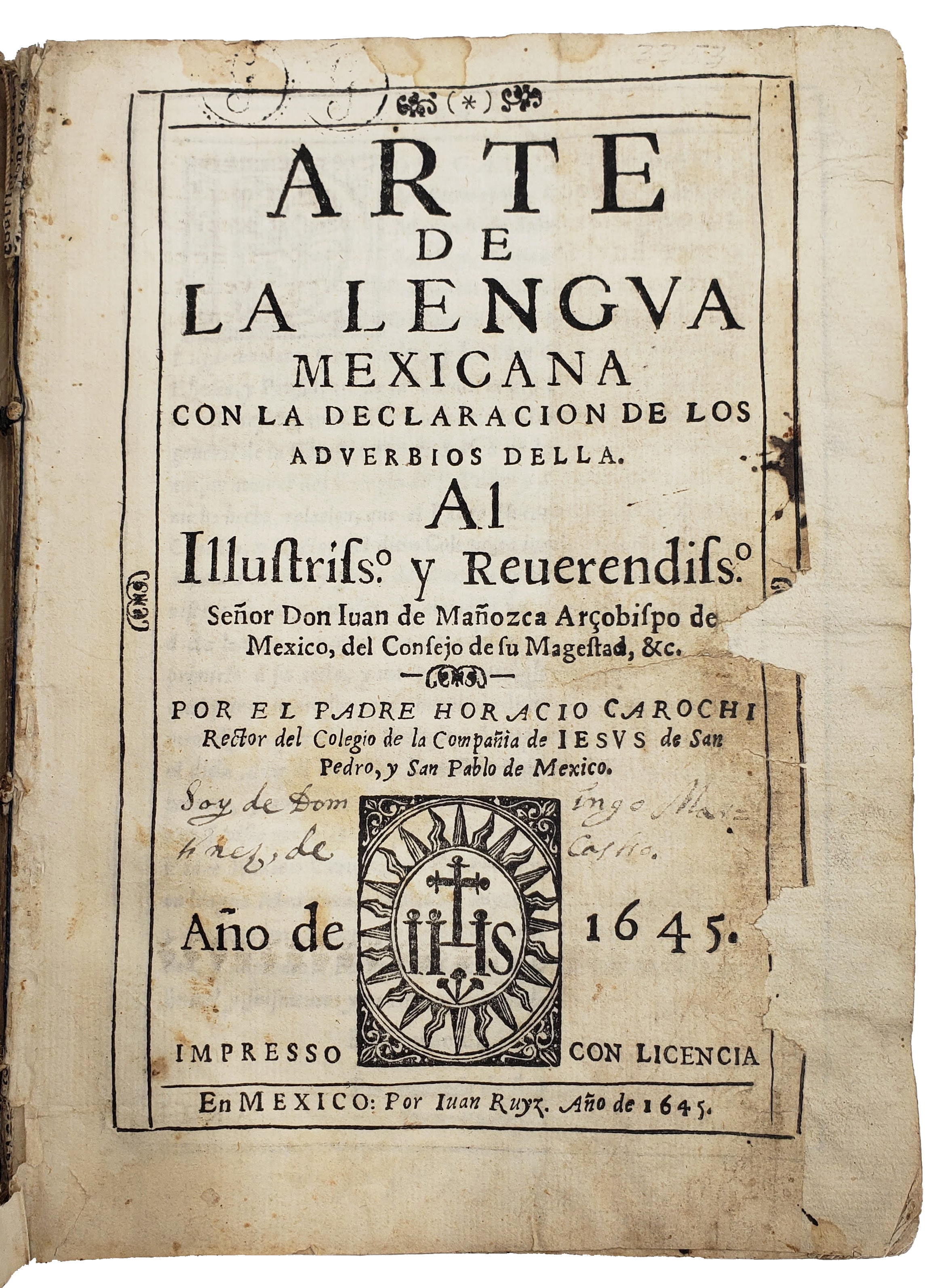
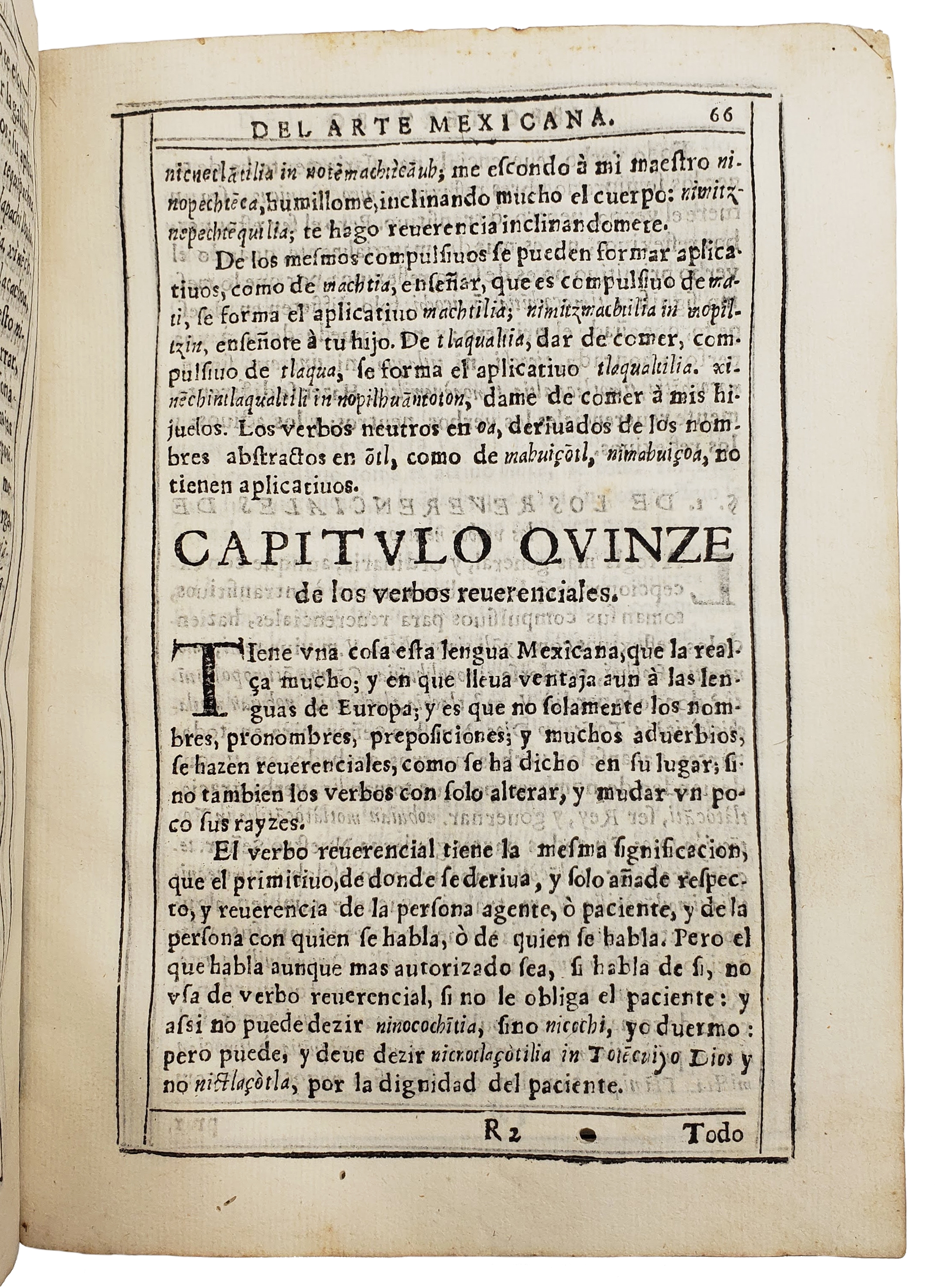
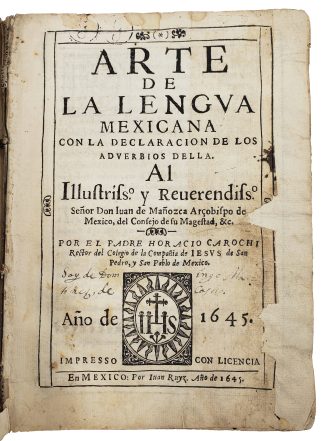
Arte de la lengua Mexicana con la declaracion de los adverbios della.
Mexico, Por Juan Ruyz, 1645£17,500.00
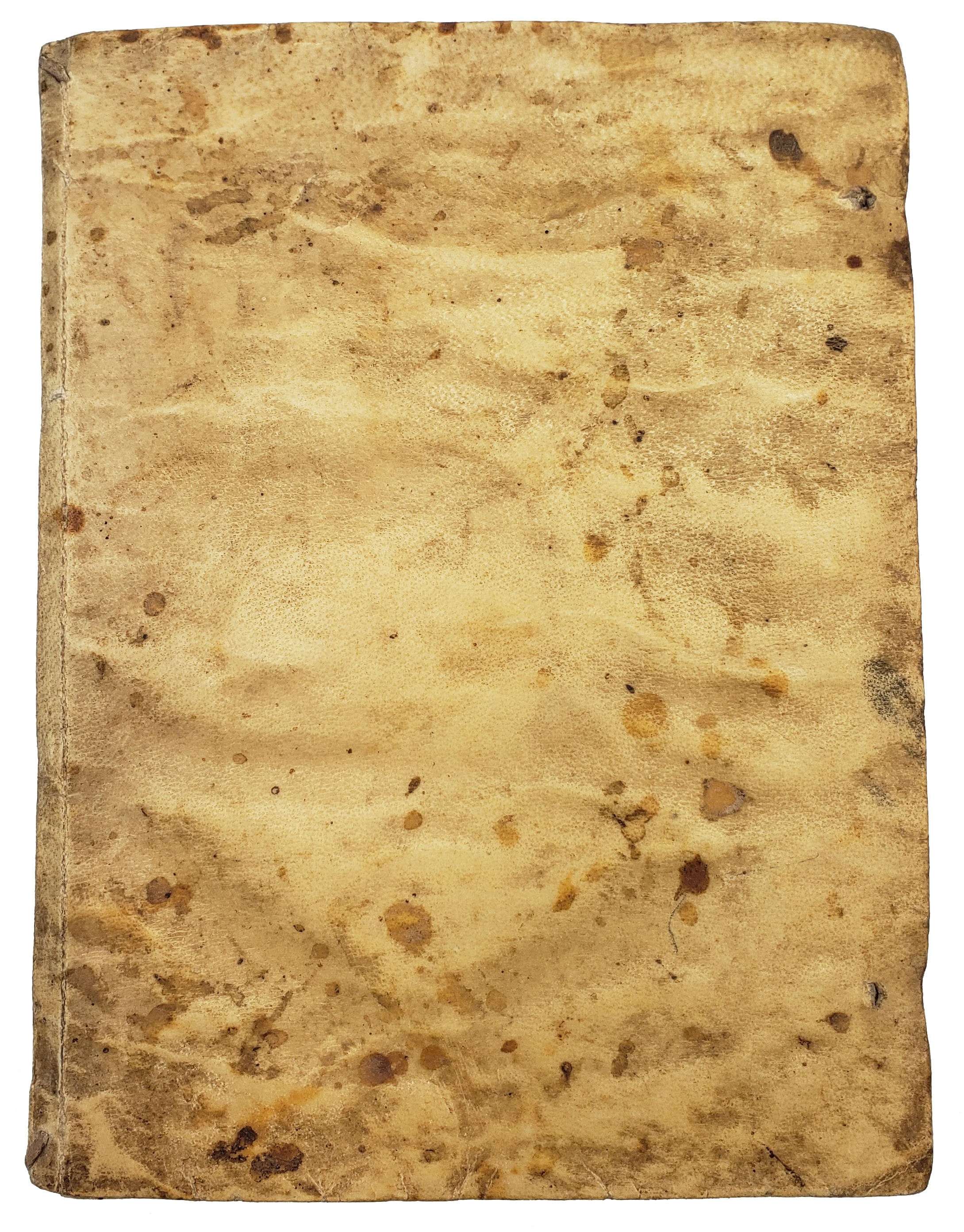
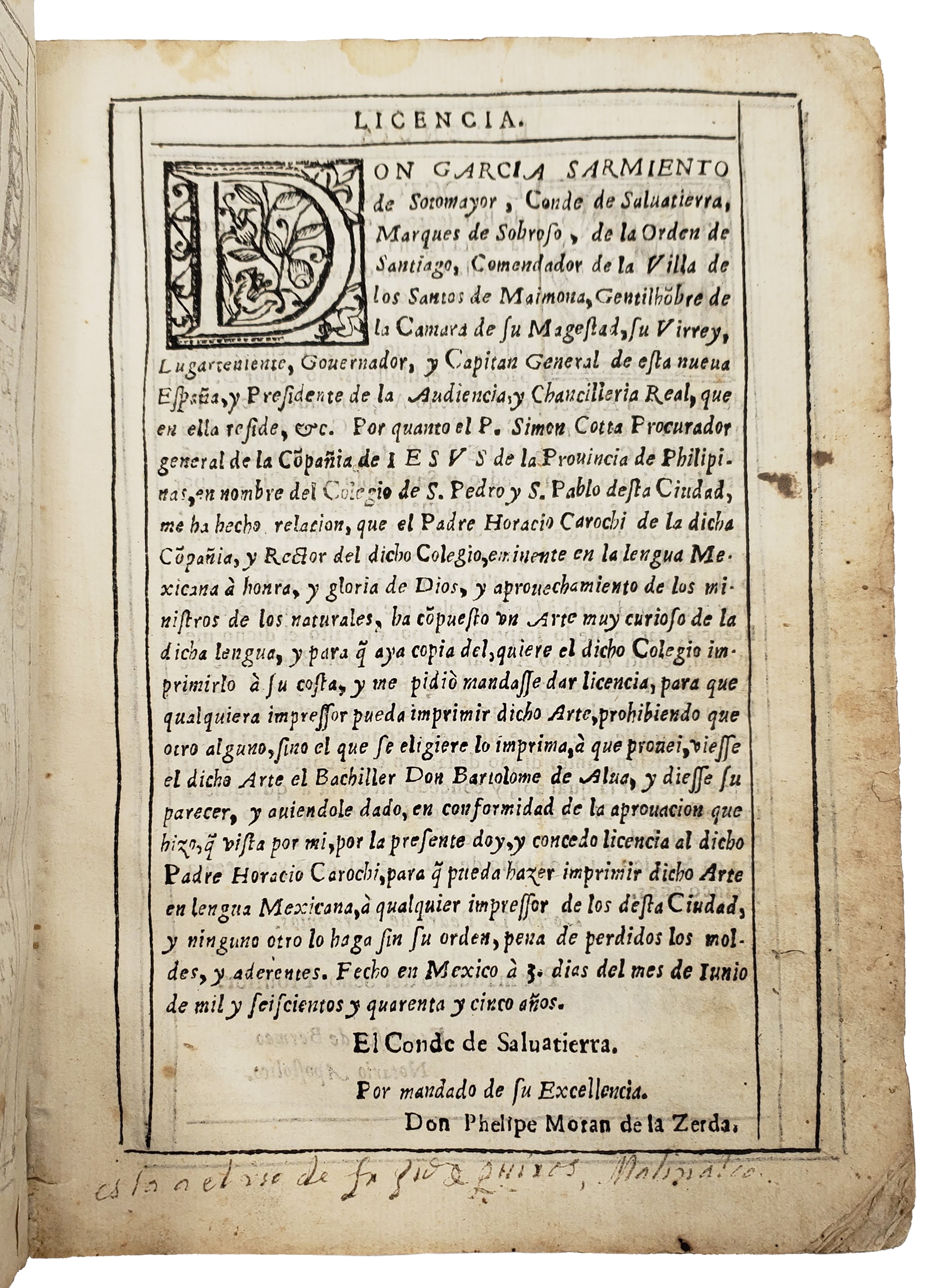
FIRST EDITION. 4to. ff. (vi) 132. Roman letter. Woodcut Jesuit device to t-p. Woodcut dedicatee’s coat of arms to *4r. Woodcut initials and tailpiece, typographical head- and tailpieces. Outer margin of t-p repaired, affecting border but not text, small ink splash, two faint monogram stamps to blank upper margin. Wormtrack to outer blank margin beginning *4r, five ll. with marginal tears/repairs, offsetting. Second wormtrack beginning D2r and continuing to Ii, diminishingly. The occasional light stain, spot or dustiness, mostly marginal, verso of last a bit soiled, a perfectly reasonable copy in original limp vellum. C17 autograph to t-p, ‘Soy de Domingo Martinez, de Castro,’ and to last verso, ‘A Don Luis de Navaña(?),’ faded C17 inscription to front fly, occasional marginalia. Marca de fuego to upper edge, initial A within heart, typically associated with the Augustinian convent in Puebla.
First edition of this influential grammar of the Nahuatl or Aztec language by the Jesuit Horacio Carochi (1586-1666), dedicated to Juan de Mañozca y Zamora (1580-1650), Archbishop of Mexico. The book deals with names, prepositions, verbs, comparatives and superlatives, adverbs and conjunctives and contains a wealth of Nahuatl vocabulary. It was instrumental in visualizing the ‘saltillo,’ i.e. the Nahuatl glottal stop, with a grave accent, e.g. è. It remained a standard work on the language and was reprinted in Mexico in 1759.
The first book printed in the New World was in Nahuatl: ‘One of the main reasons for the establishment of a printing press in Mexico centred around the need for materials to aid in the ‘spiritual conquest’ of the area, the conversion of the conquered Aztec empire to Christianity. Thus it should come as no surprise that one of the first, if not the first, book printed in Mexico would be in Nahuatl. Throughout the next three centuries, the Nahuatl language continued to occupy a position of importance in the output of Mexican presses’ (John Frederick Schwaller, ‘A Catalogue of pre-1840 Nahuatl Works Held by the Lilly Library’ in The Indiana University Bookman, No. 2 (1973), p. 69.
There are legal records dating to the late C17th and early C18th in city of Toluca referring to a man by the name of Domingo Martinez de Castro; there is also a record of a man by this name whose sister, a nun, applied for custody of a slave.
Palau III, 44870. Sabin III, 10953. Medina II, 4534. Schwaller 17. Not in Alden or JFB.