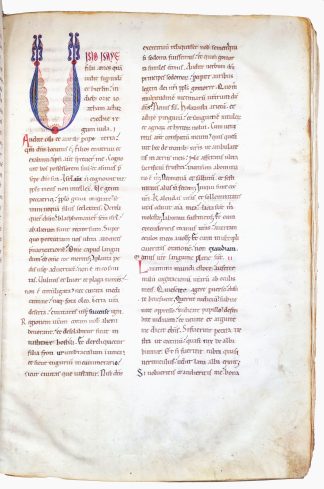

BIBLE, Cistercian
A 12TH-CENTURY CALLIGRAPHIC MASTERPIECE
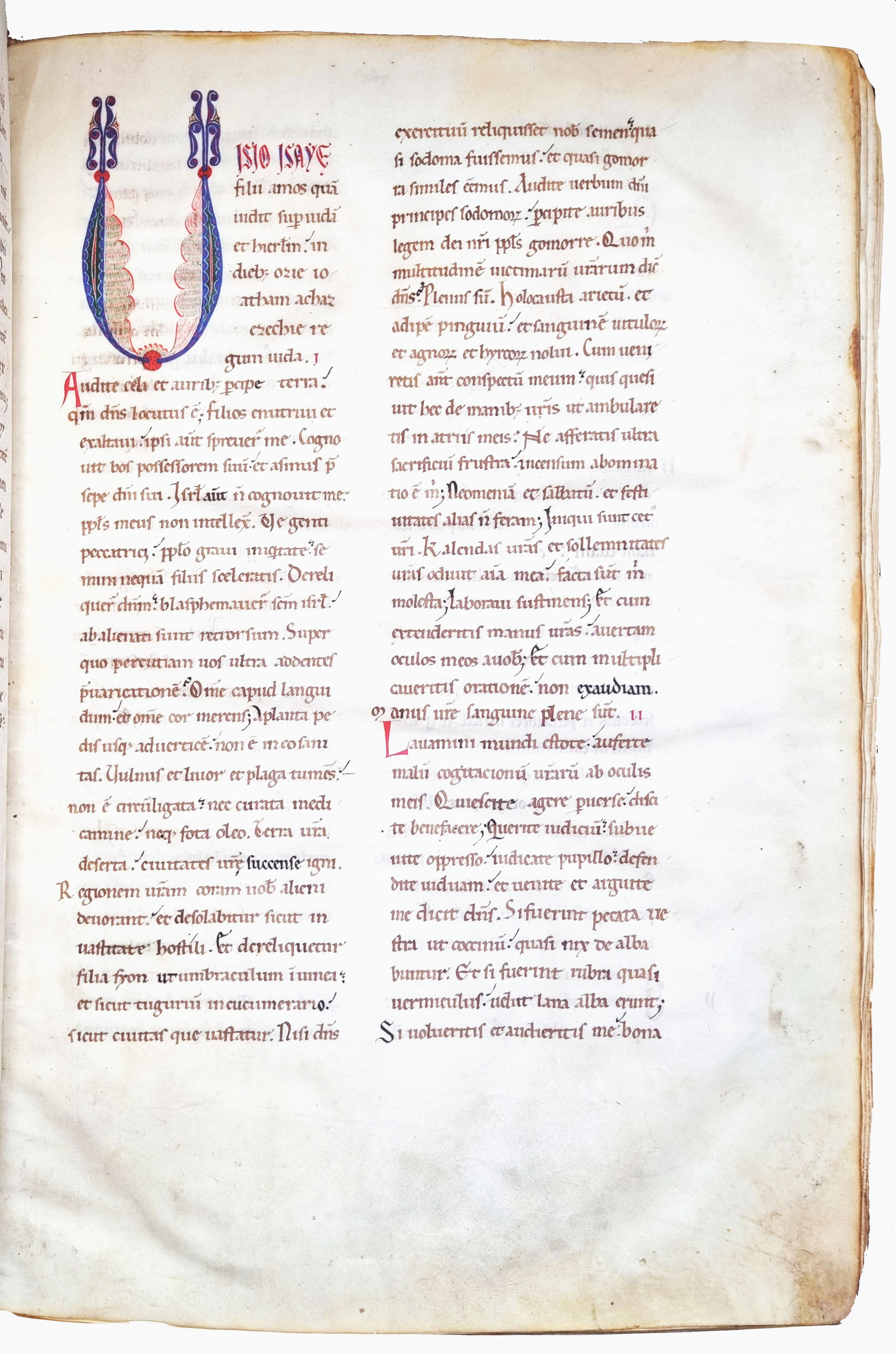
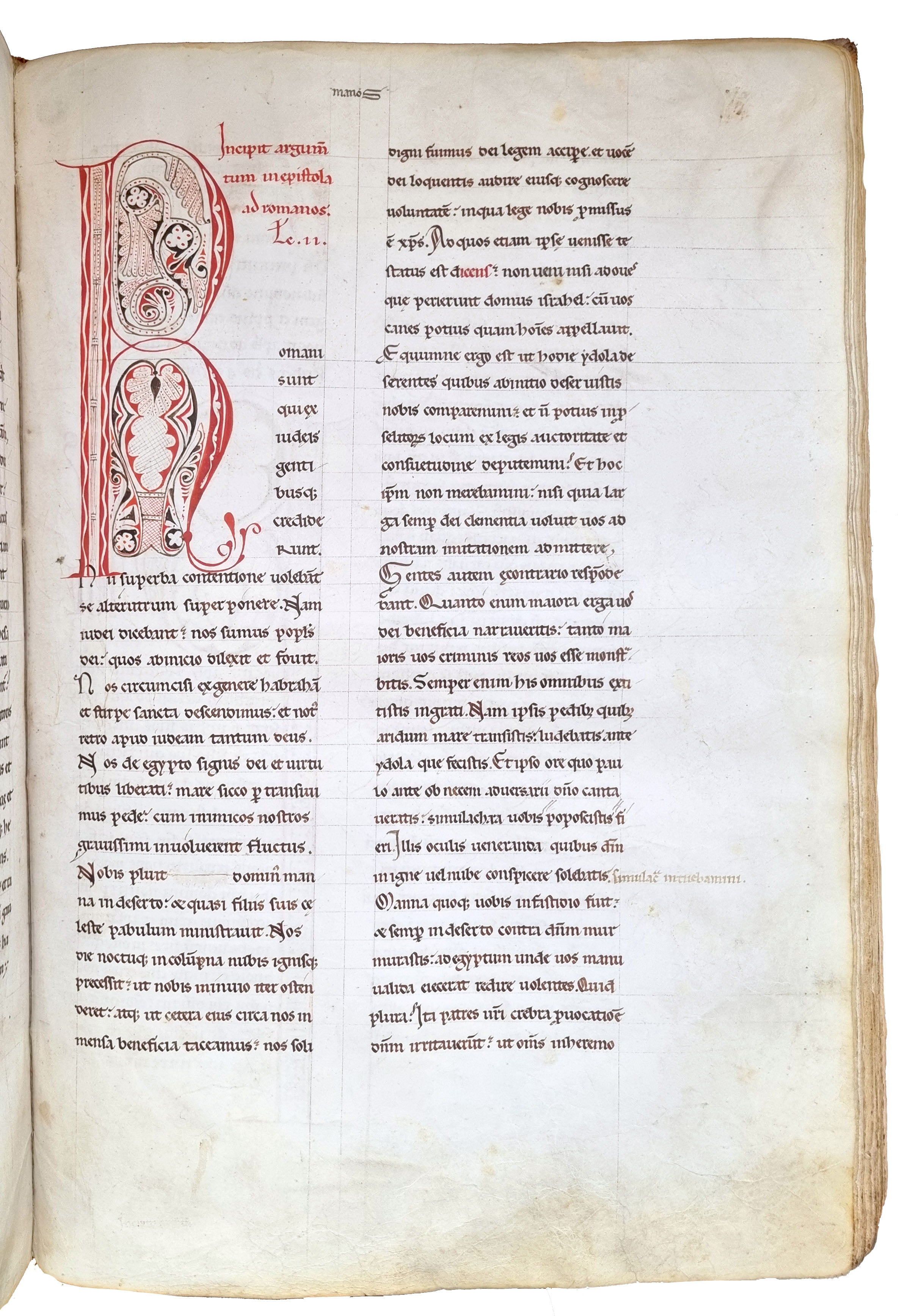
Books of Isaiah, Jeremiah, Ezekiel, Daniel, Epistles, Acts, Apocalypse and Gospels. Illuminated manuscript on vellum
Lombardy, Italy, 1170-90£250,000.00
460 x 310 mm, 251 leaves on parchment, substantially complete: I8-1 (i excised, probably blank), II-XIII8, XIV8+2 (bifolium added between vi and vii), XV-XVII8 (iii and vi as singletons), XVIII-XXXI8), wanting a quire after VIII (fol. 63), two after XXIV (fol. 194), and quire XXXII but for fol. 251, Catchwords at lower margin of last verso of quires; paper flyleaf and conjoint pastedown at beginning and end. 325 x 204 (93, 21, 90) mm; ruled for two columns and 34 lines of text in lead point, pricking at upper and lower margins and fore-edge (from recto), additional vertical line between the bounders dividing the two columns. North-Italian transitional caroline script (Littera carolina) in brown, corrections and additions in black throughout and text on additional leaves 110-111 provided by a second contemporary North-Italian Cistercian hand (Littera protogothica textualis); marginal notes referring to readings in the refectory in the Gospels: “Hic dimittatur legere in refectorio” (fols 201r, 215r, 239r) and “Hic incipiatur legere” (fols 217v, 242r); marginal chapter references in an Italian hand in grey ink throughout, c.1400. Rubrics, often with notes in small hand (littera glossularis), in lower (occasionally upper) margin as on fol. 109v, providing guidance to the rubricator, chapter numbers and marginal numbering of the biblical readings (Lc .I. , Lc .II. etc) in red throughout; running titles by rubricator in red at beginning and end of gatherings up to fol. 103r, otherwise in dark brown or grey ink by different hands to the end of the Epistles (fol. 166v).
Two large initials (9-15 lines), the first in blue, the second blue and red, both with penwork decoration in red, blue and green and followed by first words of text in red capitals touched in blue (fols 2r and 35v); one large 7 line initial in blue with reserved blank and penwork decoration in red and yellow (fol. 95v); similar large initials (6-13 lines) in red, occasionally extending into the margin, at beginning of texts (fols 119v-242v); minor initials (2-4 lines) in red, green and red (fol. 15v) or blue and red (fol. 107v) throughout. Three large initials (16-25 lines) in red with reserved red and black penwork decoration supplied to the additional text on fols 110r, 111r and 111v.
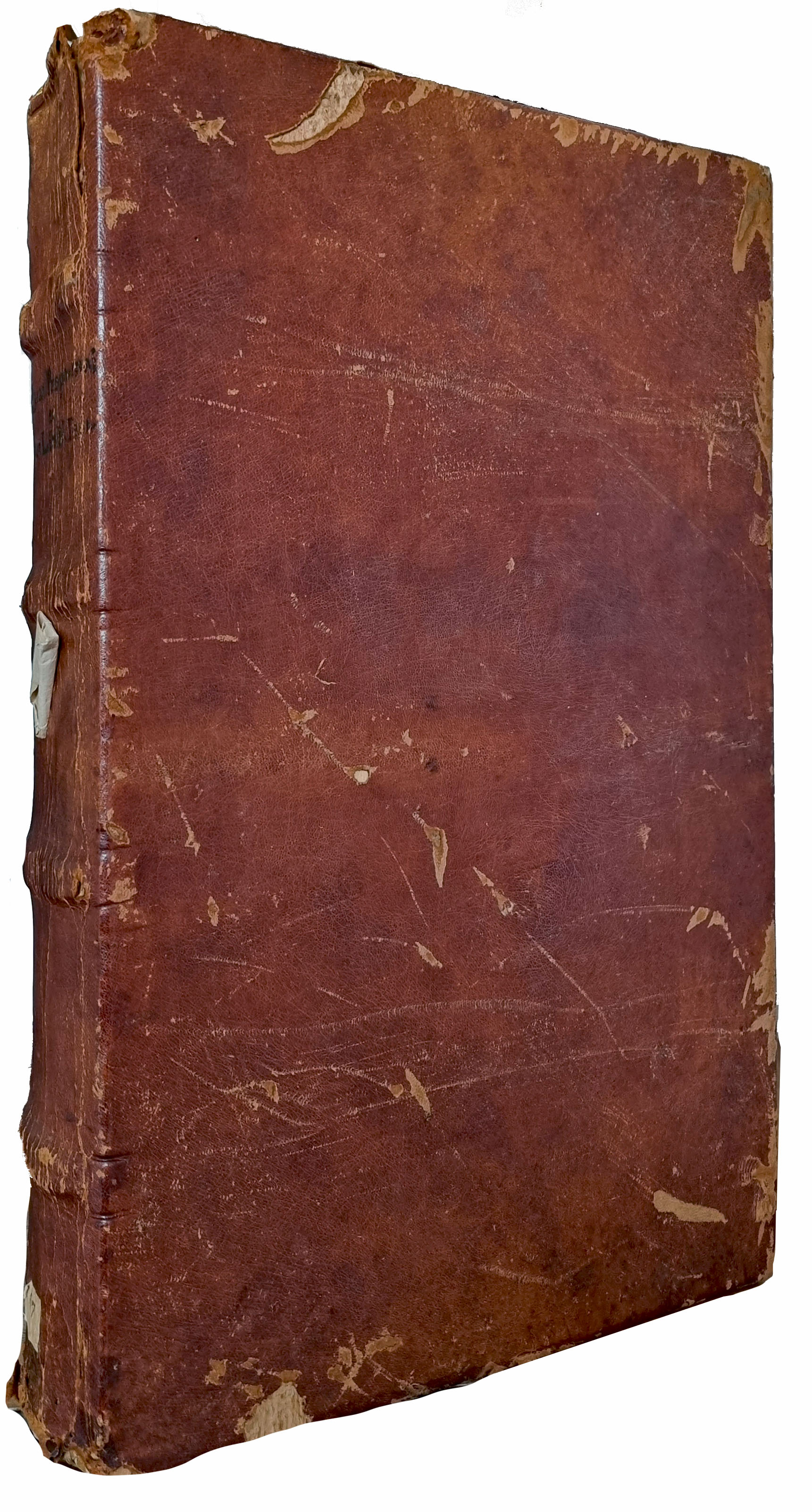
Strong Italian parchment, with a number of natural flaws and some cuts with medieval repairs (see fol. 20); fol. 119 with a long horizontal cut, but complete; lower margin of fols 232-233 and 237 and fore-edge of fol. 238 cut away; overall in good condition. In later brown sheepskin over unbevelled wooden boards, some scuffmarks, sewn on four double-split spine bands of alum-tawed skin, two endbands on parchment core with yellow sewing thread, now loose, and title “Quat. [?] Proph. mai / et / Plus [?].Lib.N.Test.” on spine, shelfmark “229” in black ink on upper pastedown; shelfmarks “35” and “67” on spine, all 17th/18th century.
This large splendid volume was produced in Northern Italy in the second half of the twelfth century for the use of a monastery of the Cistercian order, established in 1098 by Robert of Molesme at Cîteaux. The unusual order of the biblical texts (Isaiah, Jeremiah, Ezekiel and Daniel; Epistles, Acts and Apocalypse; the Gospels), reflects a programme of reading in the Night Office carried out in Cistercian communities from Advent to Epiphany, Lent, and Easter to Pentecost (ordo librorum ad legendum; Reilly 2005, pp. 169-170). The Cistercians included the reading of the four Gospels into the refectory element of their annual cycle, but excluded the Passion narratives as highlighted in the manuscript by the marginal notes “Hic dimittatur legere in refectorio” (fols 201r, 215r, 239r) (Webber 2010, pp. 20 n. 47, 32). The large size of the volume, the two-column layout, well-spaced lettering and use of red minor initials throughout were designed to assure legibility for reading aloud. The principal hand is a very fine example of top quality 12th century calligraphy, elegant yet clearly legible. The additional punctuation supplied by the second hand in a darker ink in accordance with the Cistercian practice of indicating short, medium and long pauses in the reading, supplied further helpful guidance (Parkes 1992, pp. 195, 197). The textual corrections by this second hand testify to the attention paid to the correctness of biblical texts in accordance with St Bernard of Clairvaux’s wishes.
The sober yet elegant decoration of the initials also follows the Cistercian practice of austerity, including restrained decoration in their manuscripts. The initials to Isaiah, Jeremiah and Daniel are similar in style to those found in a 12th-century manuscript Bible now in the Biblioteca Civica “Angelo Mai” at Bergamo, MA 600 (olim Alpha V 17; see Zizzo), with an almost certain Cistercian origin. The three initials in red with reserved and red and black penwork decoration on leaves 110r-111v are consistent with the decoration of Cistercian manuscripts produced in Italy, as in two 12th-century codices; an Office lectionary at Harvard, Houghton Library, Typ 223 online at http://hcl.harvard.edu/libraries/houghton/collections/early_manuscripts/bibliographies/Typ.cfm, from the Abbey of Morimondo (Ferrari 1993, p. 299) and from Acquafredda Abbey (see Ferrari 1993, p. 295) a 12th century Commentary on The Old Testament-Pentateuch by Isidore of Seville and Hugh of St Victor’s Rex Salomon, now at Berkeley, Bancroft Library, MS UCB 16.
Both these manuscripts have covers almost identical to the present, and bear similar titles on the second spine compartment, also found on Jerome’s Commentary on the Minor Prophets, now Milan, Biblioteca Nazionale Braidense, Gerli MS 12, identified by Ferrari (Ferrari 1999, pp. 36, 41-42, 44) as one of the manuscripts mentioned in the twelfth-century book list from the Abbey of Morimondo found on the last verso of the Abbey’s Office lectionary mentioned above (Houghton Library, Typ 223).
The present manuscript shares the same 18th-century provenance, if not origin, as those three manuscripts now at Milan, Berkeley and Cambridge. From the beginning of the eighteenth century many manuscripts from Cistercian abbeys in Lombardy were collected at the monastery of S. Ambrogio in Milan to support the programme of cultural reform promoted by the Congregation of St Bernard in Italy and the Austrian government. On arrival at S. Ambrogio, they may have been supplied with new covers and a manuscript title on the spine. The present manuscript must have arrived about the same time, when the influx increased exponentially with the suppressions of the monasteries in the last quarter of the century; many of these codices were then dispersed onto the open market. A good number were acquired by the Biblioteca Ambrosiana, but many entered private collections, such as those of the marchesi Trivulzio of Milan, Count Francesco Giovio (1796 – 1873) of Como, and Matteo Luigi Canonici (1727 – 1805), Jesuit and antiquarian of Venice, further dispersed through later sales.
A twentieth-century note in English pencilled on the upper flyleaf suggests that this manuscript may have passed through the hands of the bookseller Giuseppe (Joseph) Martini of Lugano between 1913 and 1942, though it is not mentioned by Ferrari in her list of Cistercian manuscripts described in Martini’s catalogues (Ferrari 1999, pp. 34-35). It was Martini who probably invented the myth of provenance from the library of the celebrated humanist Paolo Giovio (1483 – 1552) still recorded in the literature of some Italian Cistercian manuscripts (see Berkeley, University of California, Bancroft Library, MS UCB 16, in Digital Scriptorium).
In stock