

ABANO, Pietro d’, et al.
THE FUGGER COPY
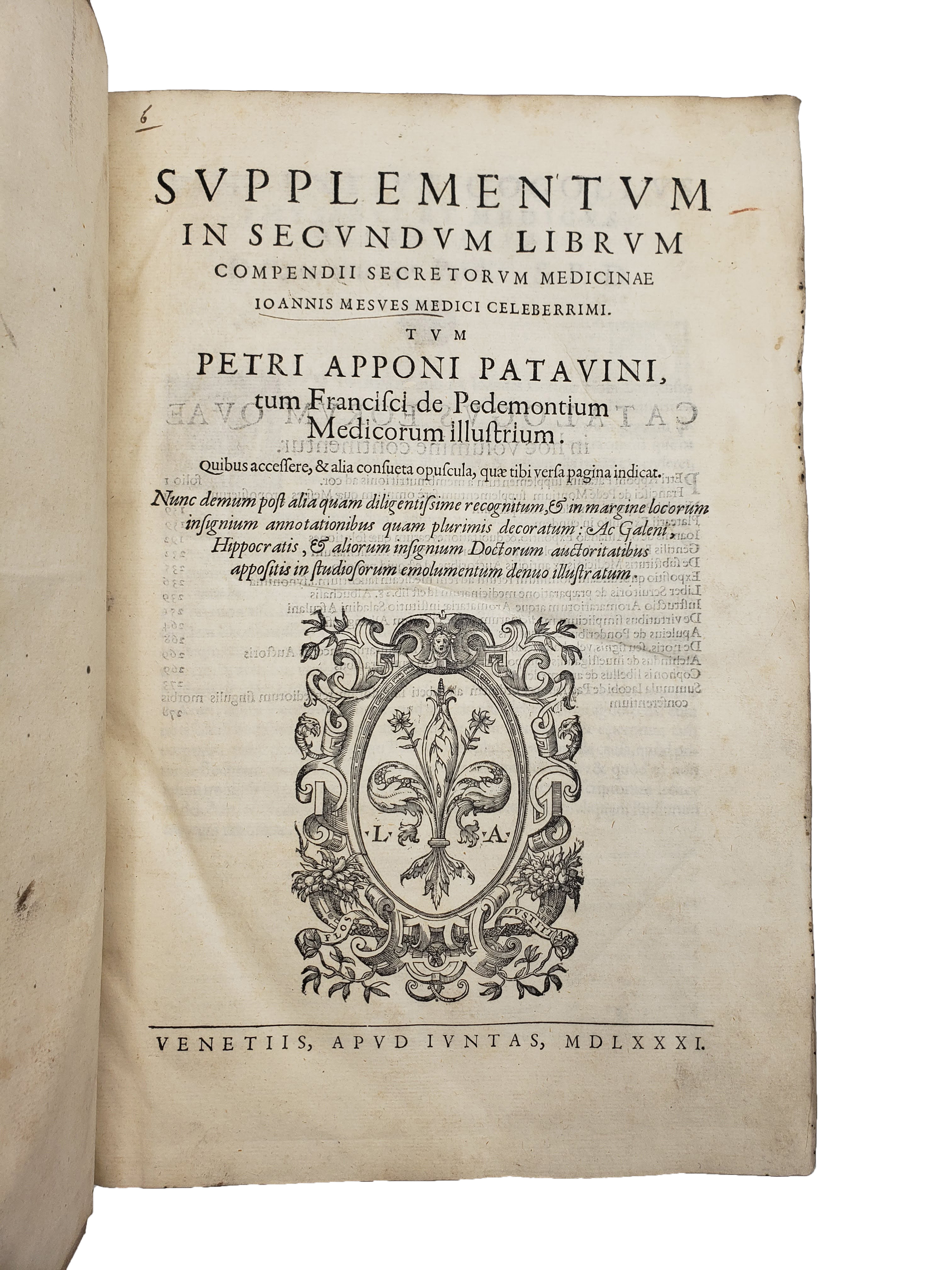
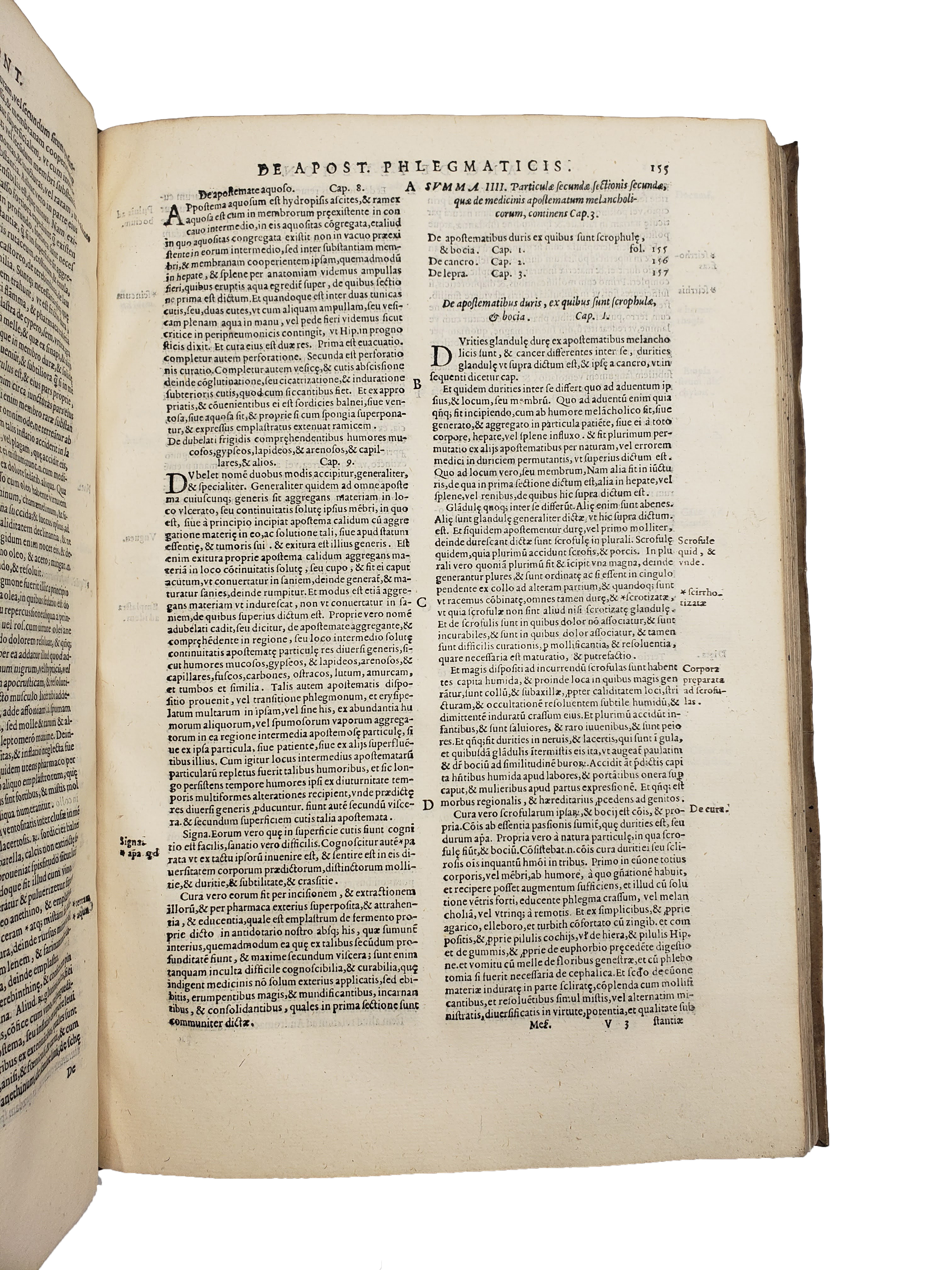
Supplementum in secundum librum compendii secretorum secretorum medicinae.
Venice, Apud Juntas, 1581.£2,750.00
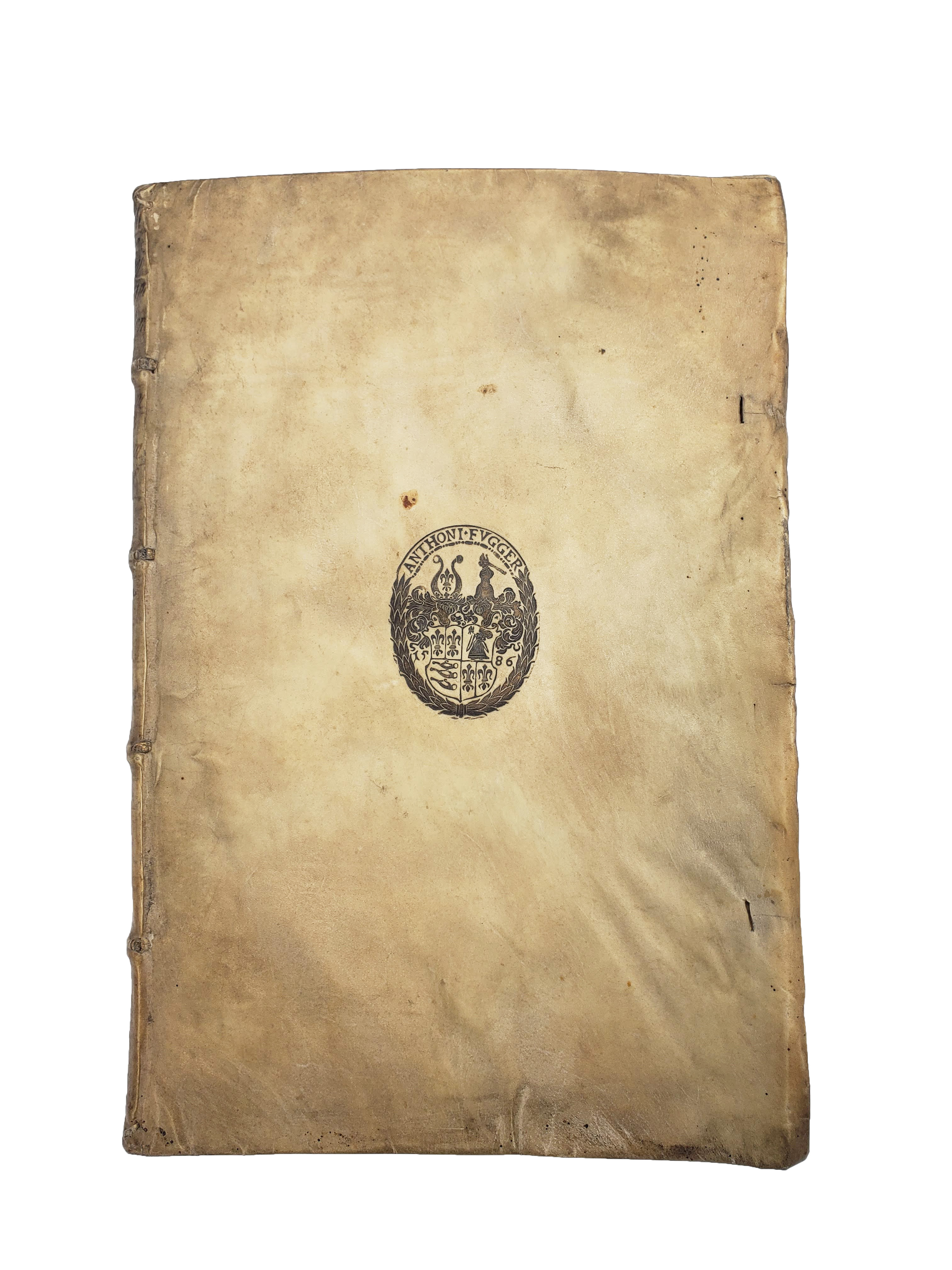
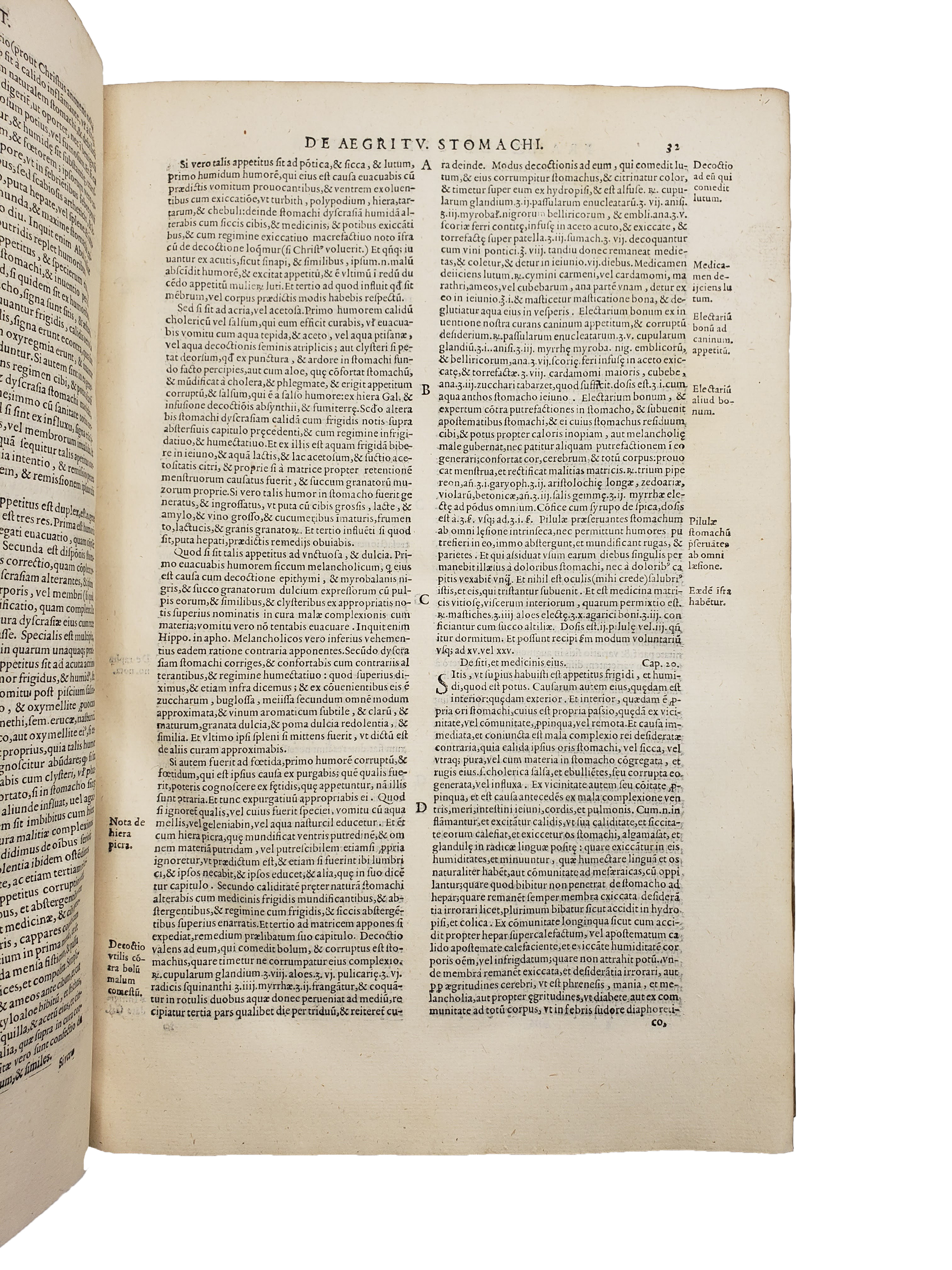
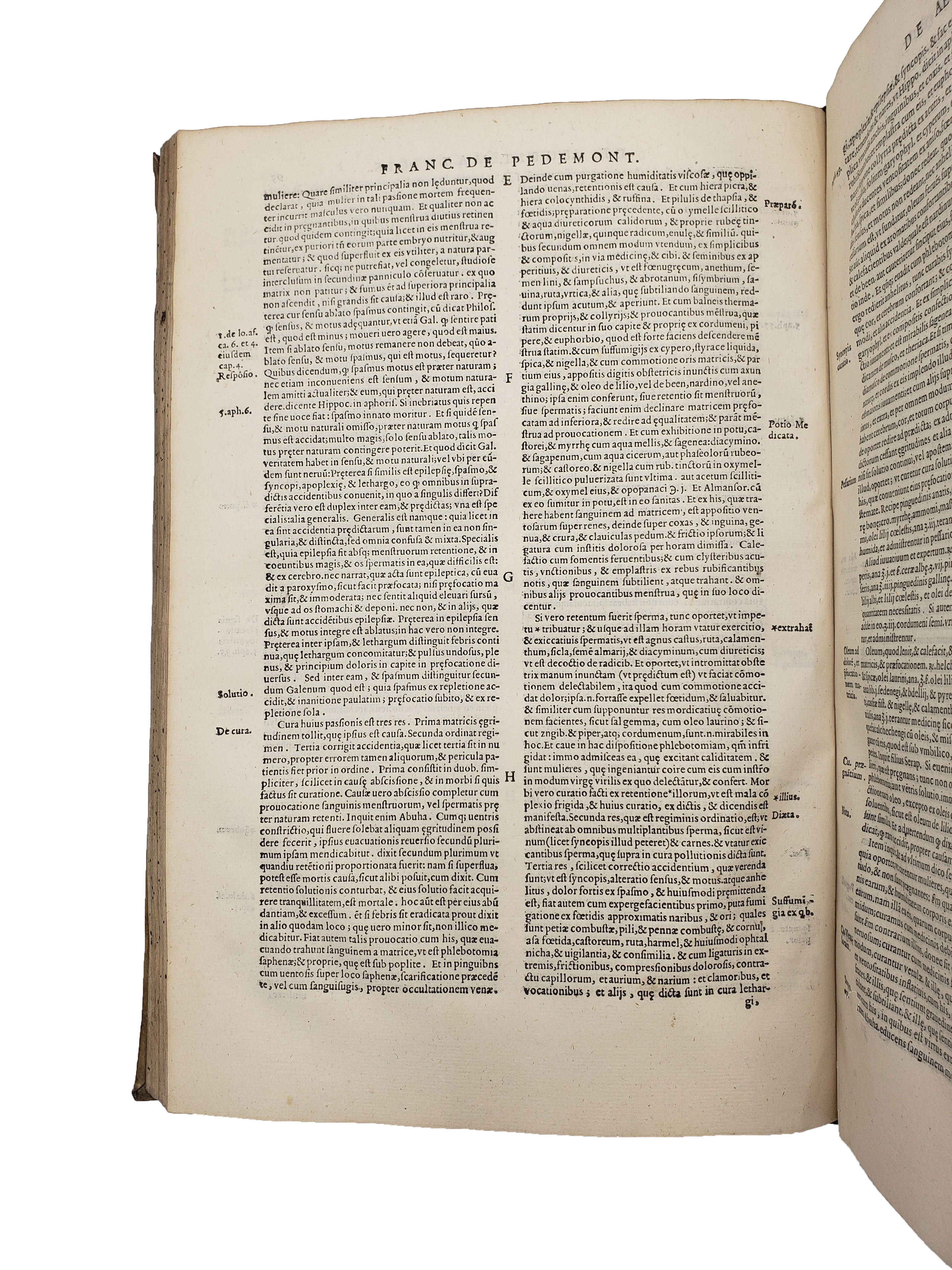
Folio in sixes. ll. (vi) 277 [i] (xii). Roman letter, double column. Woodcut printer’s device to t-p. Light waterstain to early upper outer corners, diminishing, a very good, clean copy in original limp vellum, gilt supralibros to upper cover with arms of Anton Fugger, 1586, oxydized, edges sprinkled. Later ms. inscription (autograph, ‘Vening’?) to ffep.
A rich and uncommon compendium of practical medieval medical texts, including commentaries on a medical text known as ‘Pseudo-Mesue’ and Latin translations of several medieval Arabic medicinal and pharmaceutical works. This was the second part of the two-volume Opera de medicamentorum purgantium, edited by Giovanni Costeo and Vincenzo Cogotto, issued by Junta in 1581, though it appears it could be published separately (‘proxime prodit’): it has a separate collation and title-page.
This copy is from the library of Anton Fugger die Jüngere (1552-1616), grandson of Anton Fugger (1493-1560), who collected a large private scholarly library of almost three thousand books, nearly a third of which were medical (Paul Lehmann, Eine Geschichte der Alten Fuggerbibliotheken (Tübingen: 1956), I. 185; for his supralibros see II. 116-117).
The compendium in three books known as the Compendii Secretorum Medicinae or Canones Universales was attributed to the fictitious author Mesue the Younger, or Pseudo-Mesue: ‘These [texts], with the additions of Petrus [d’Abano (1259-1316) and Franciscus Pedemontanus (d. 1319)] &c., were the common text-book of pharmacology and therapeutics in the Middle Ages … Probably Latin compilations of the C10th or C11th, they may have been given, for the sake of prestige, the name of the real Mesue (Joannes Mesue Damascenus – Yuhanna ibn Masawayh, c. 777-857’ (Osler, p. 303). Heirs of Hippocrates differs slightly: ‘It is now believed that a Latin author (perhaps an Italian) of the early thirteenth century assumed the name of Mesue, hoping thereby to gain ready recognition of his works … [They] were accepted as genuinely Arabian and held such a place of importance that they went through more than a dozen editions between their first printing in 1471 and 1500’ (p. 21).
The texts of pseudo-Mesue appear in the first part, this second part contains the commentaries of Abano and Pedemontanus on the De Aegritudine. Pedemontanus goes into far more detail on illnesses of the heart, stomach, intestines, liver and spleen, and covers fevers of various kinds as well as sanguine, phlegmatic and melancholic abscesses. The remaining works are: the Antidotarium Nicolai, a medieval book of recipes, with the additions of Jean de Saint Amand (d. 1303); a very brief work on dosages by Gentile da Foligno (d. 1348), with a list of medical synonyms; the Liber Servitoris of Albucasis or al-Zahwari (d. 1013), a pharmaceutical manual, followed by a second manual, the Liber Saladini of the fifteenth-century physician Saladini d’Asculo, with a long list of simples divided into categories, and a third short manual by the Spanish Arabic doctor Albengnefit or Ibn Wafid (d. 1074); a very short work on weights and measures, the Liber Apulei, and another by the ninth-century Arabic polymath Alchindi, with tables; and the Ars Medendi or ‘art of curing’ of Copho, a twelfth-century doctor of the School of Salerno.
EDIT 16 CNCE 27626. For the first part see USTC 842298 and NLM 3131. Edition not in Osler, Heirs of Hippocrates, Wellcome, Adams or BM STC It. Durling 3131: ‘Supplementum … has special title-page.’