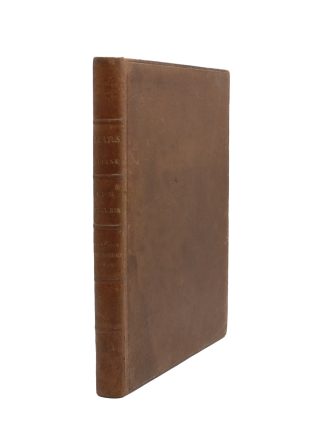

AVIENUS, Rufus Festus.
THE FIRST CELESTIAL PLANISPHERE AND ABRACADABRA
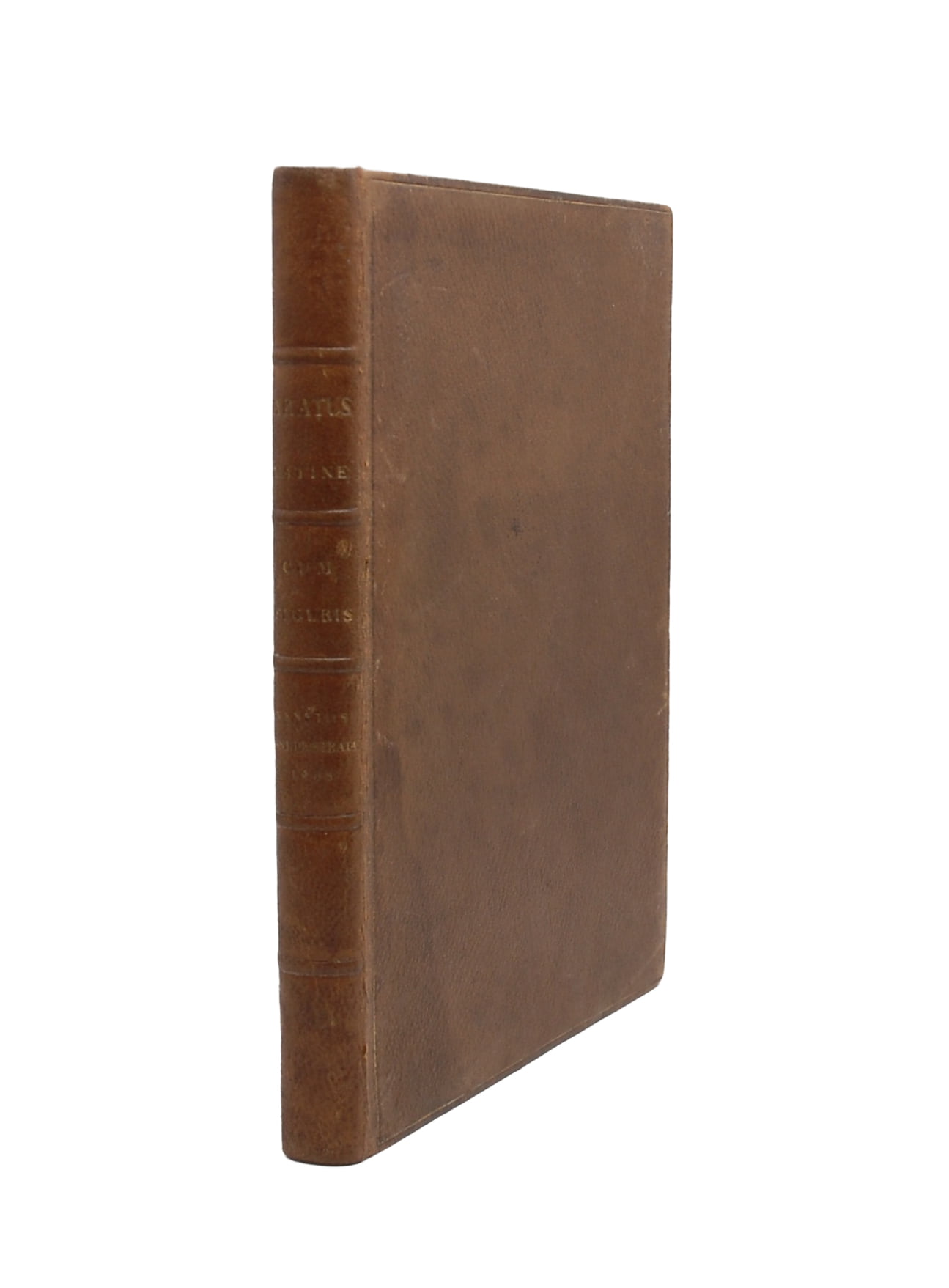

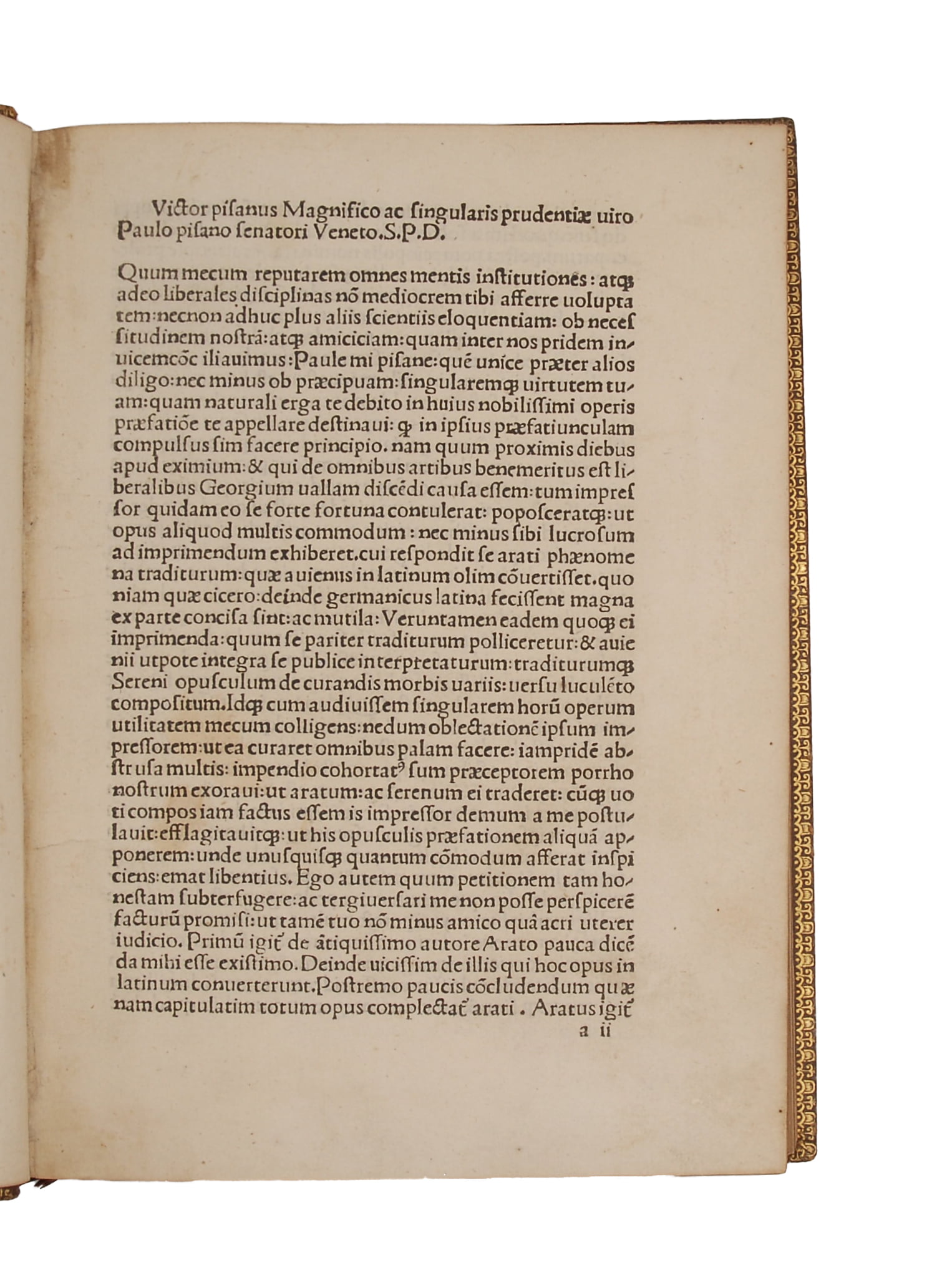
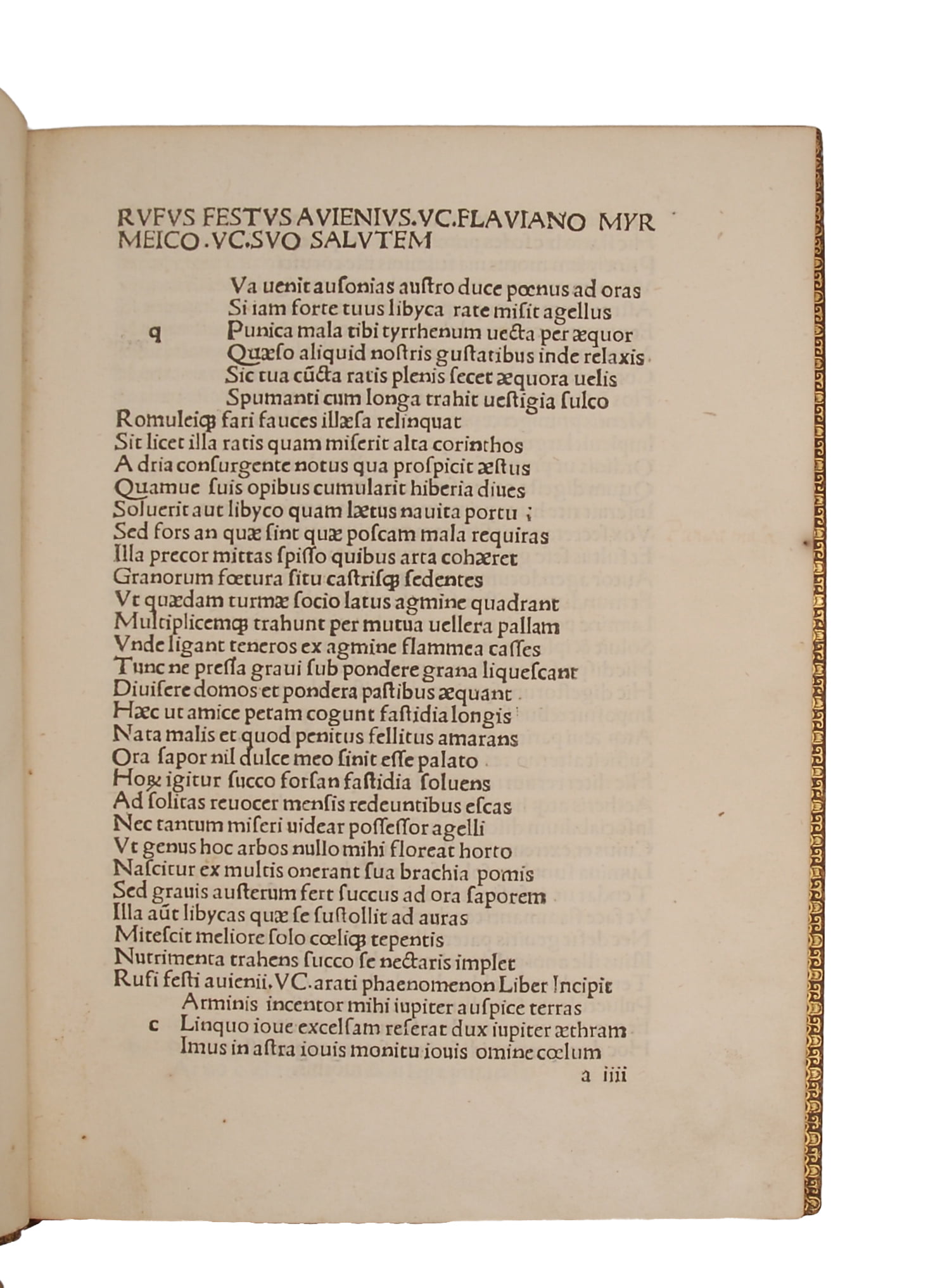
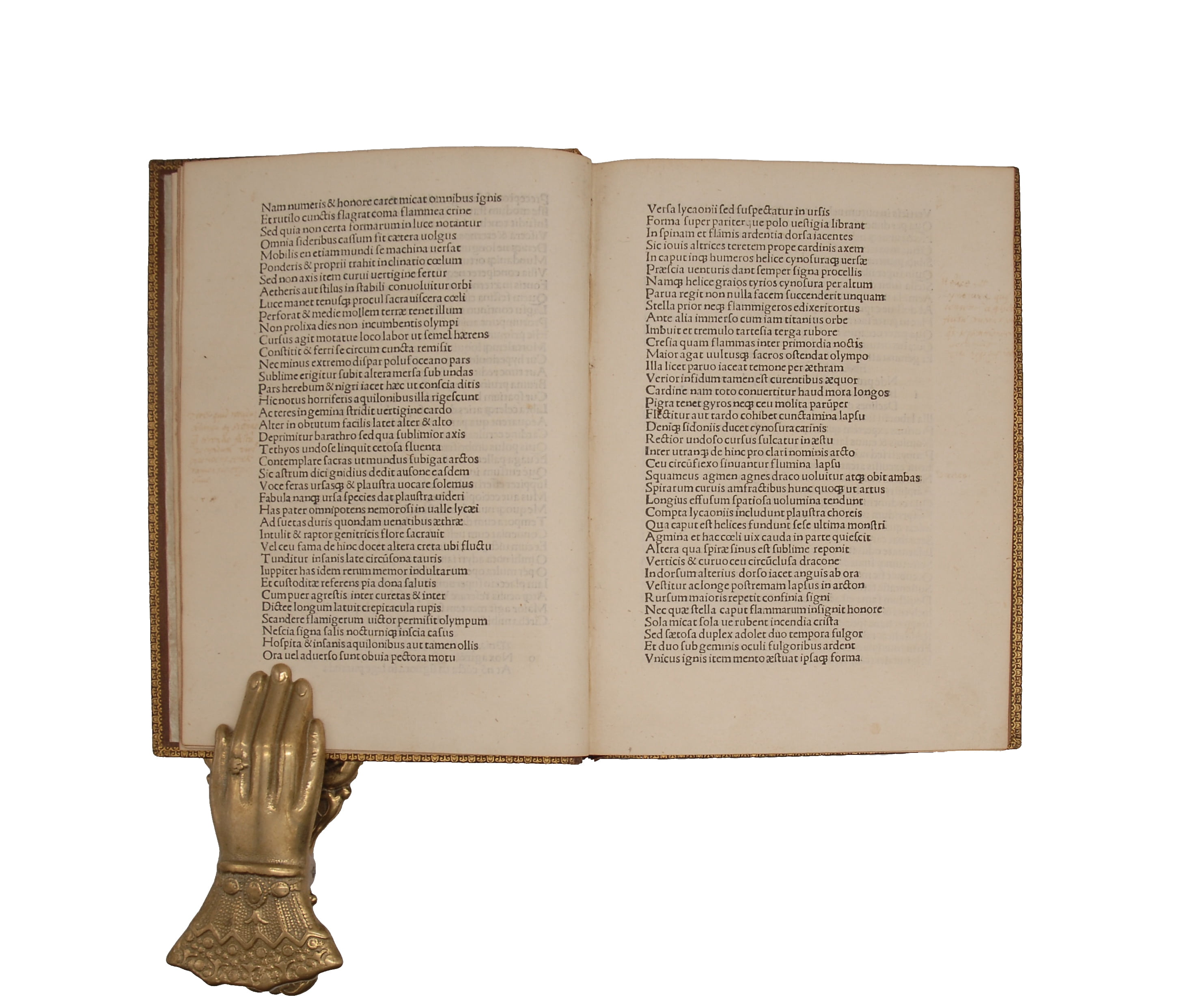
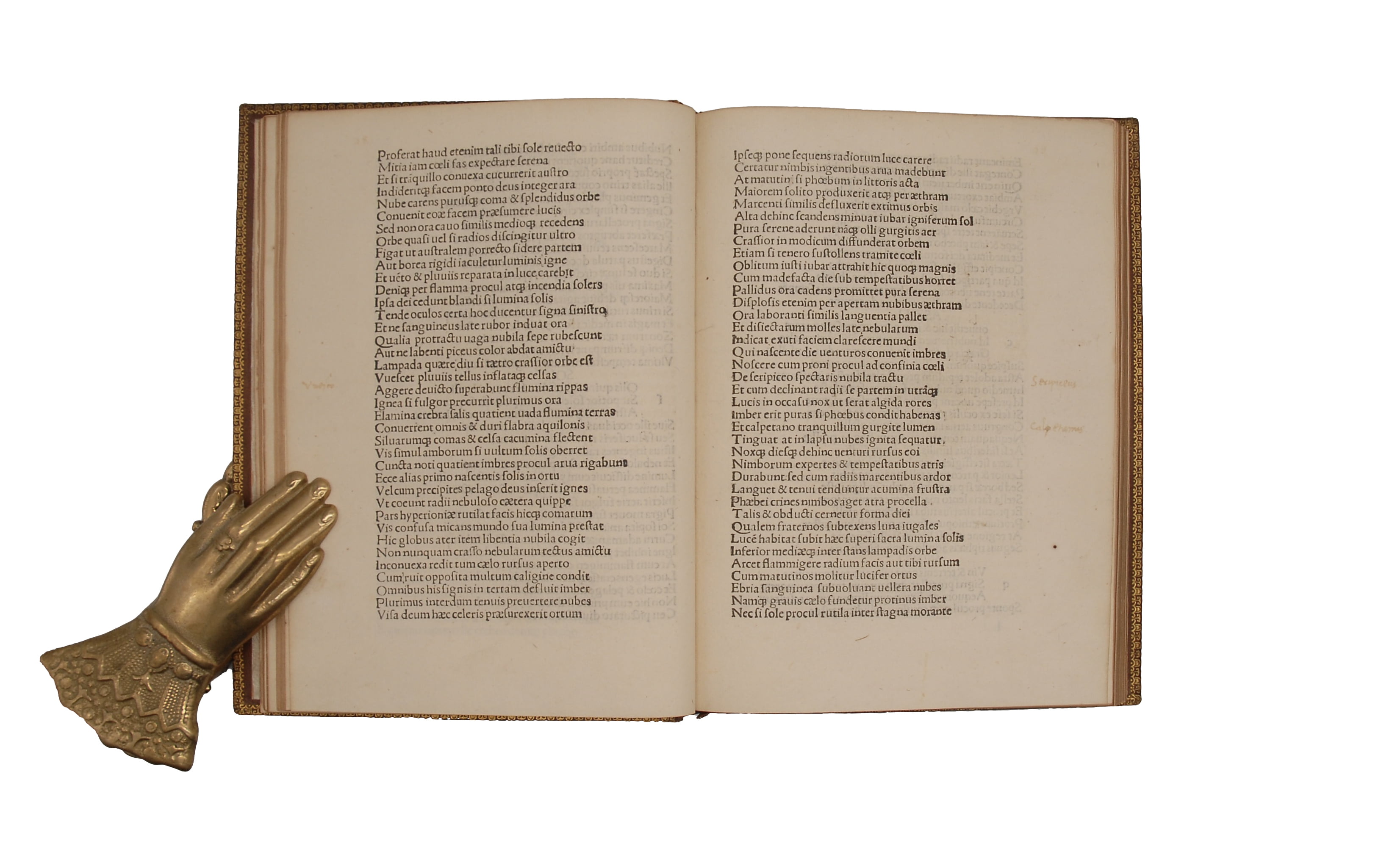

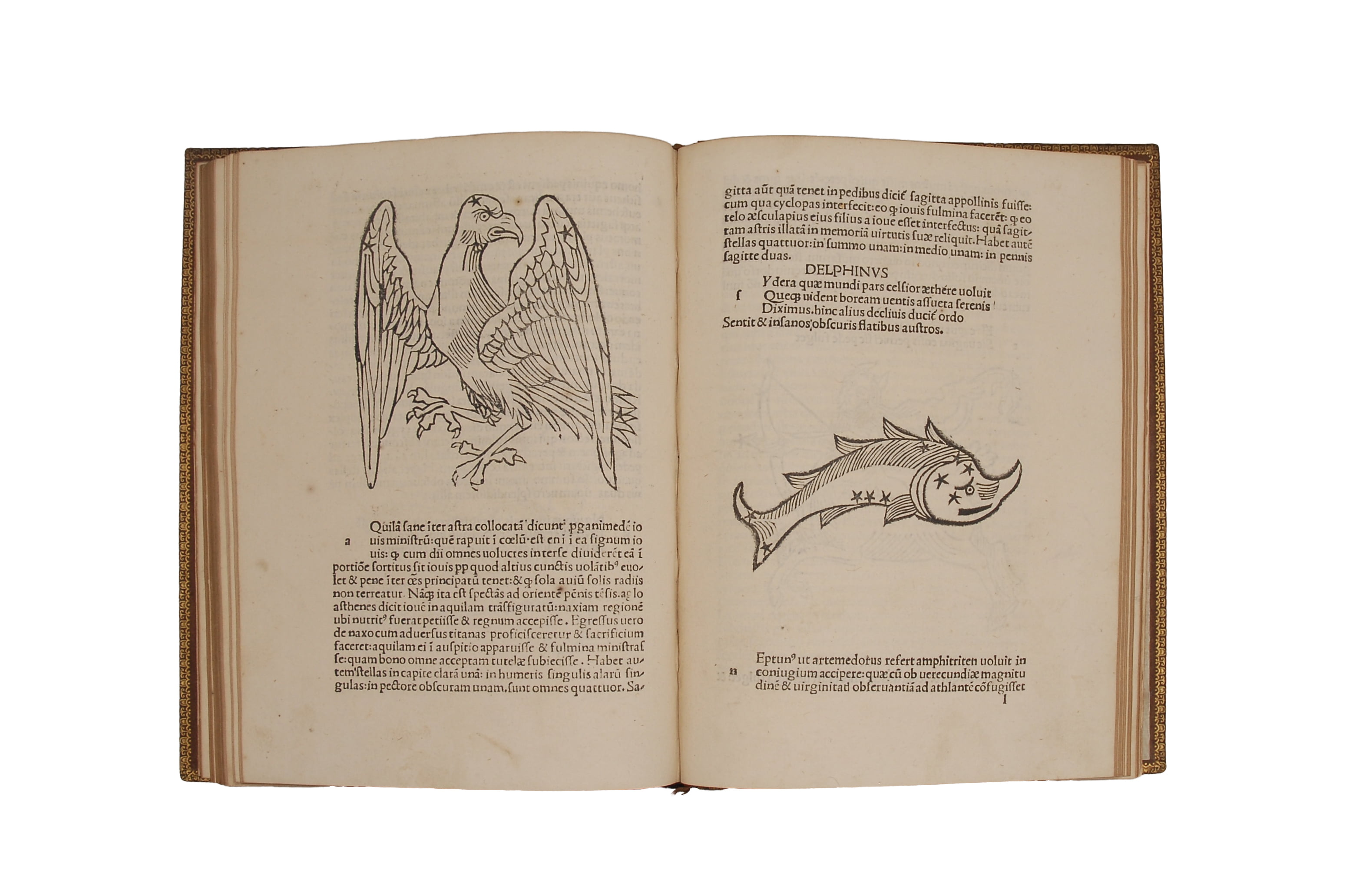
Arati phaenomena.
[Venice], [Arte & ingenio Antonii de Strata Cremonensis], [1488]£25,000.00
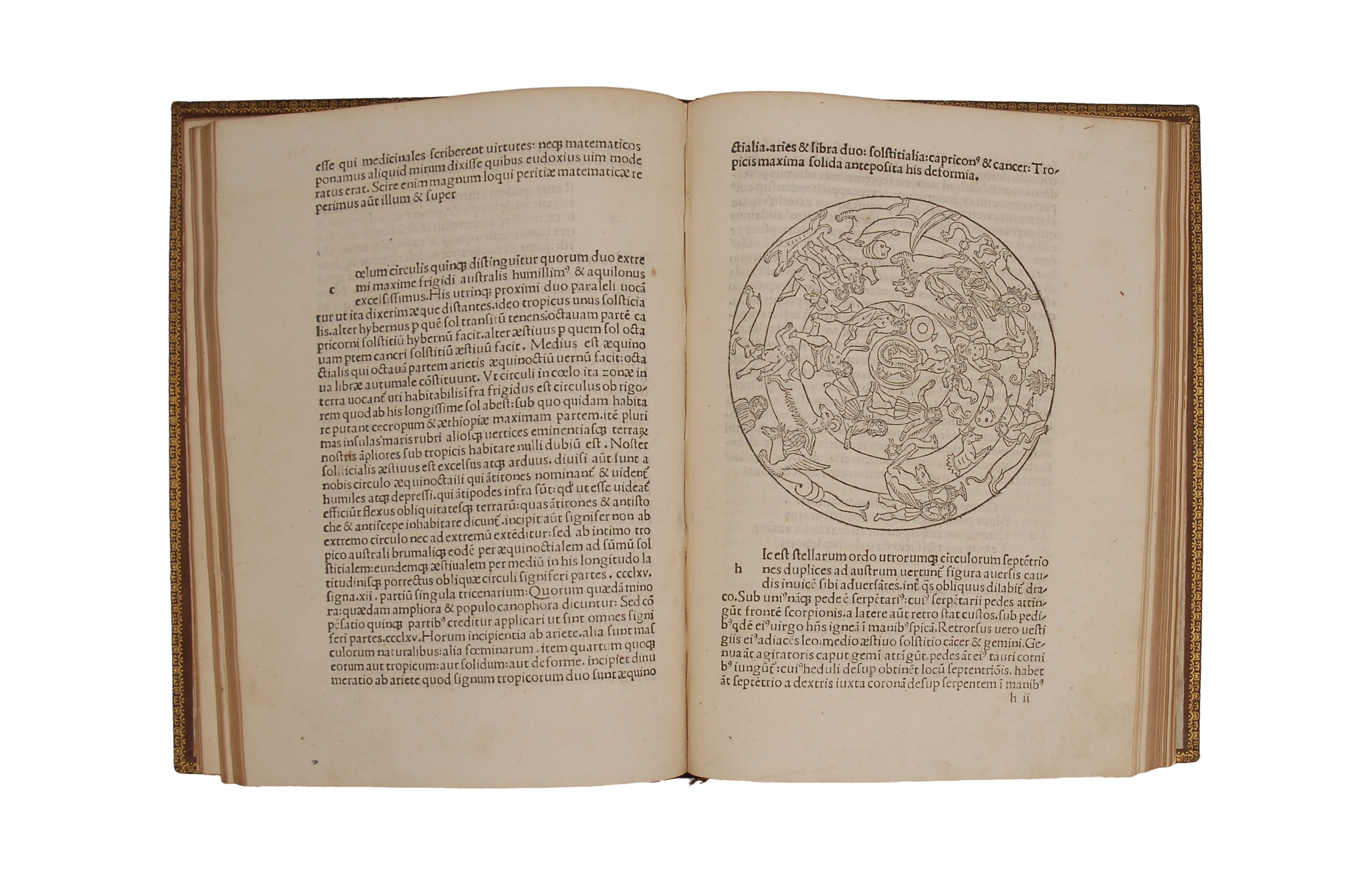
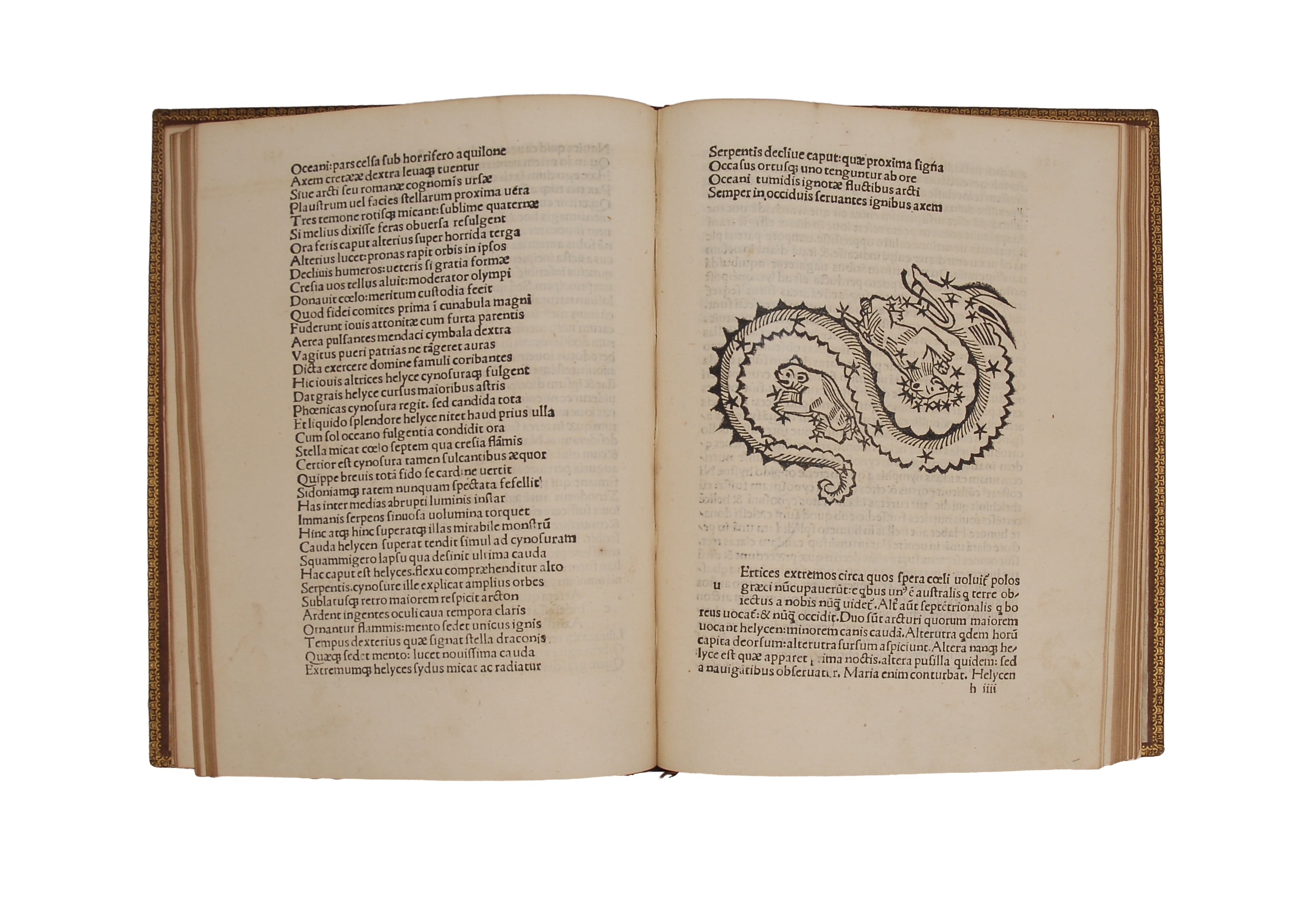
FIRST EDITION 4to. 6 works in 1, 121 of 122 unnumbered ll. (lacking blank a1), a9 b-o8 p8, g8 and last two blanks. Roman letter. 38 handsome large woodcuts of planisphere, zodiac and constellations. A little light yellowing, margins minimally finger-soiled in places, four ll. slightly browned, faded marginalia likely lightly washed, tiny ink burn to n3 affecting one letter. A very good, well-margined copy in early C19 crushed morocco, slightly mottled, silk eps, spine gilt-lettered, raised bands, inner edges gilt, a.e.g., scattered minor stains, edges a little scuffed. c1800 armorial bookplate of Thomas Gaisford and F.B. Lorch’s label to front pastedown.
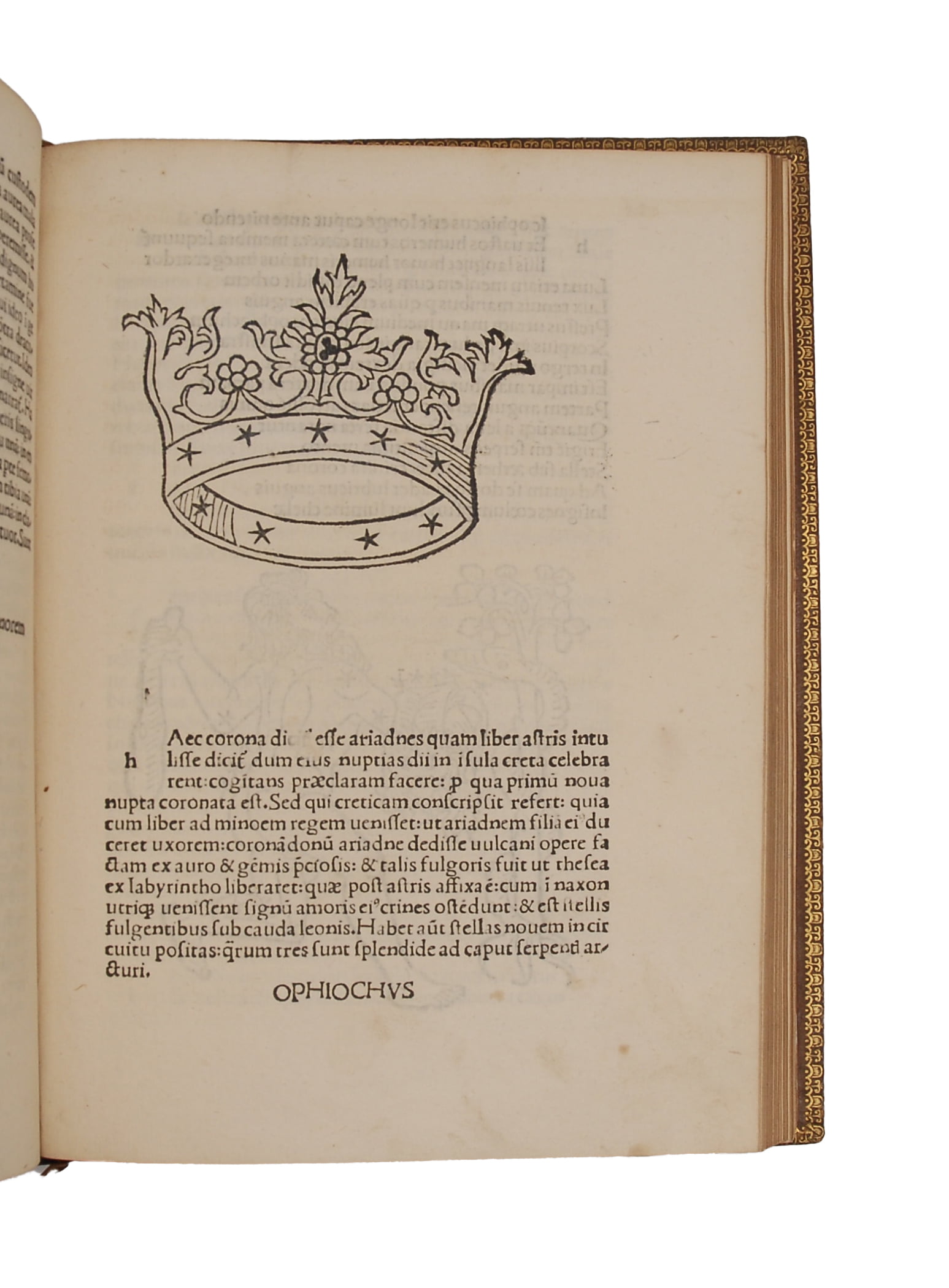
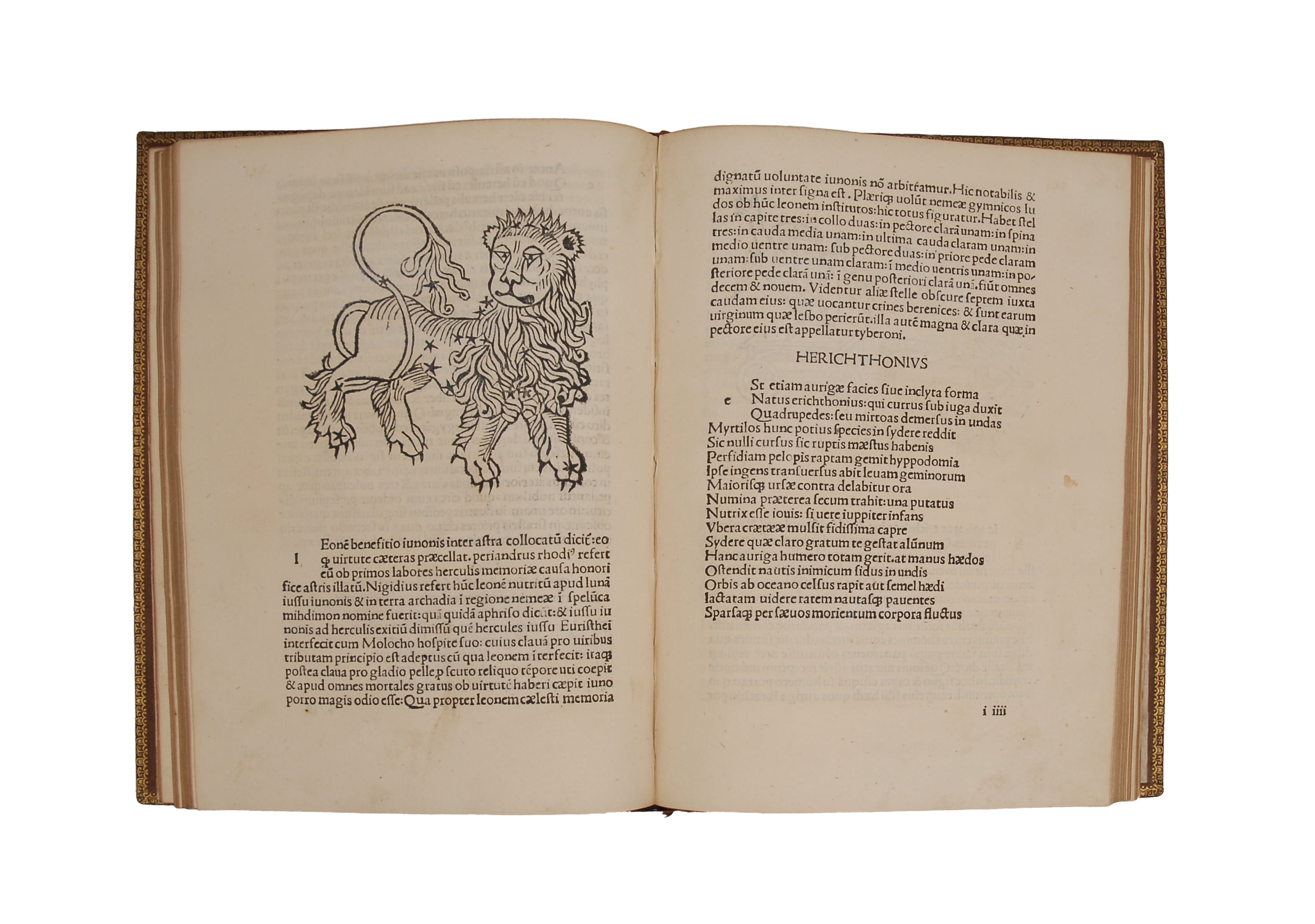
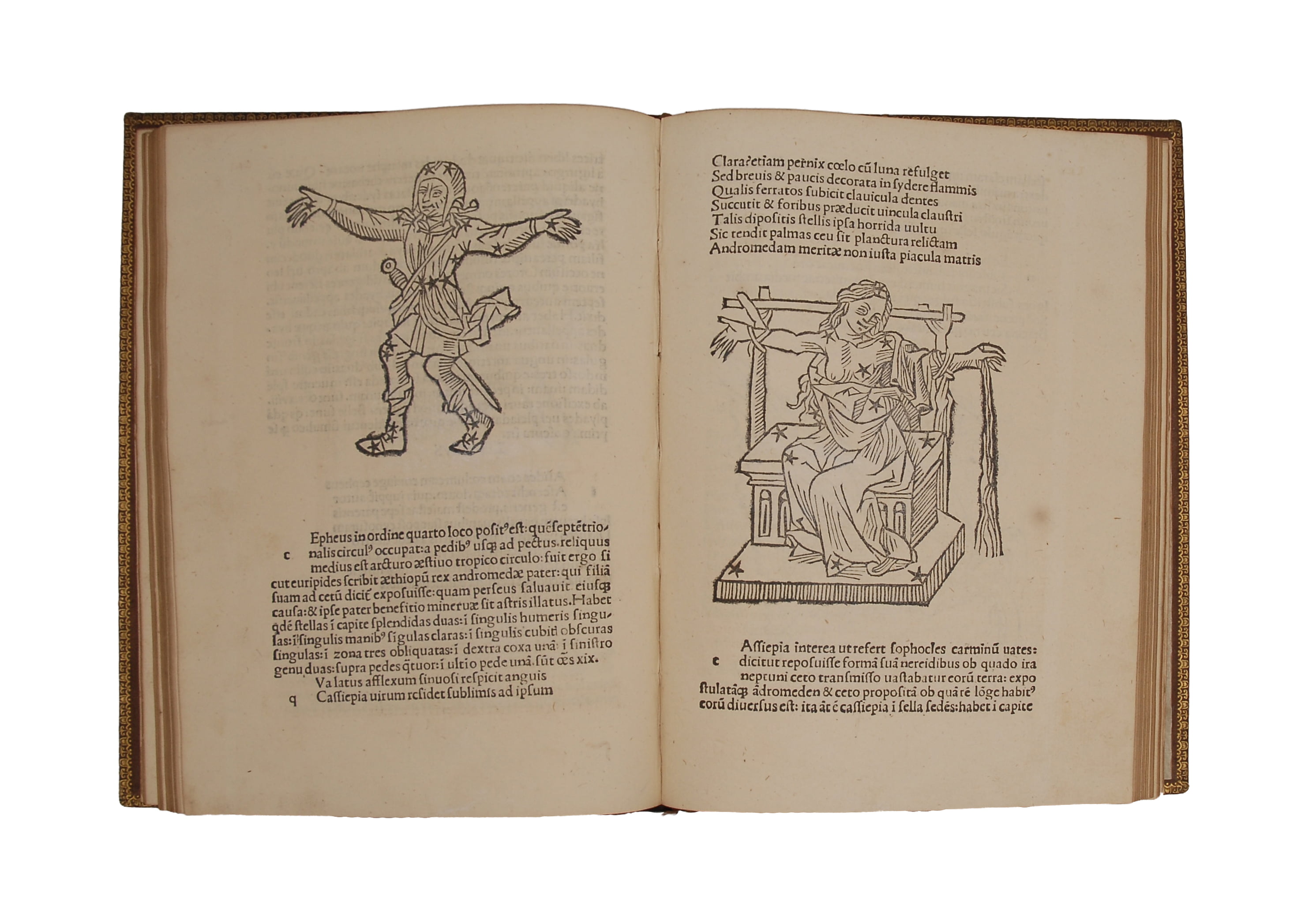
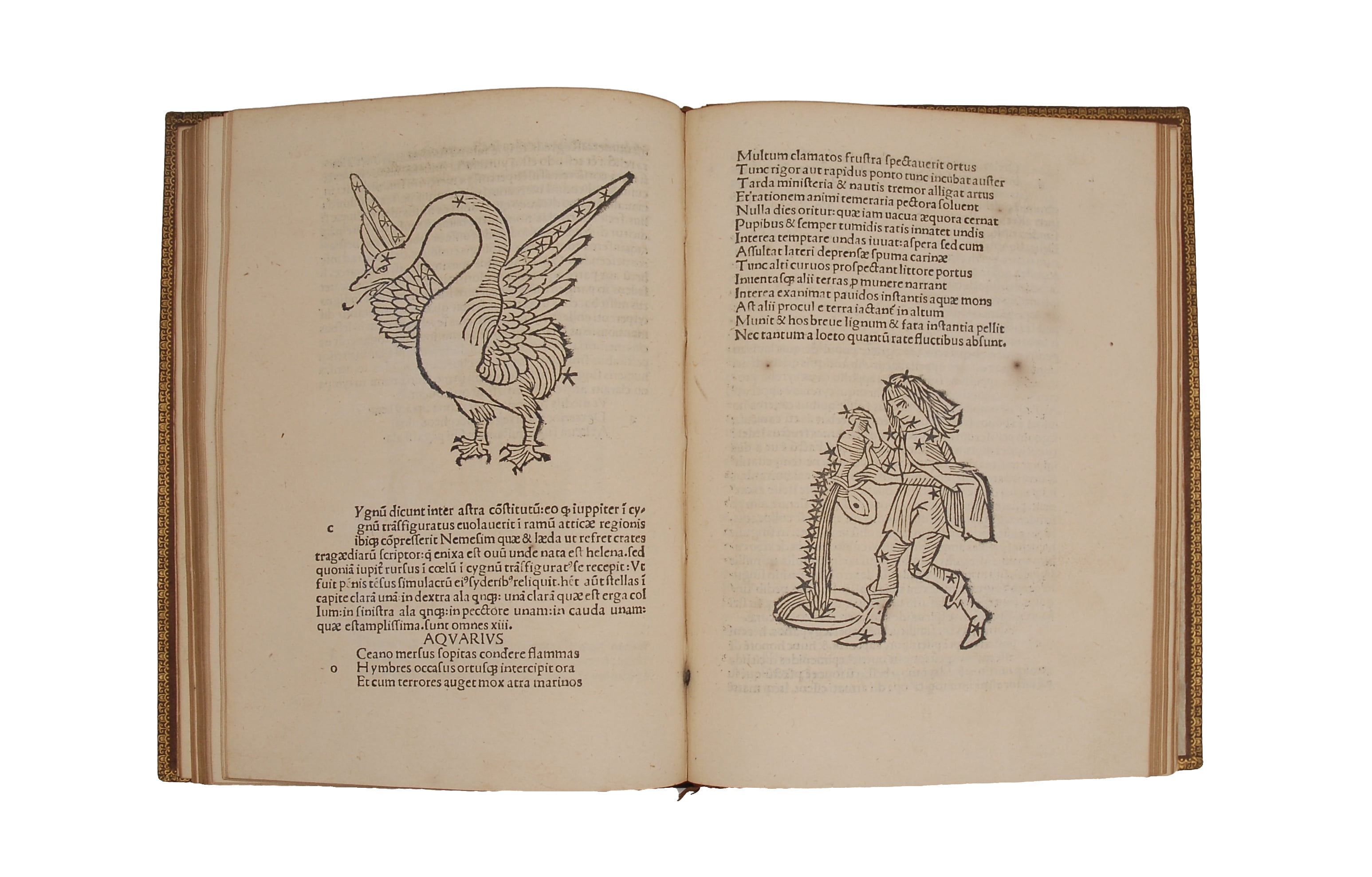
A very good, well-margined copy of the first edition, of this lavishly illustrated volume—with the first celestial map printed in a book, in the form of a planisphere. ‘This printed map is a much-simplified, mirror-image version of the planispheres found in humanist mss. The fact that it is presented as a mirror-image to the rest of the planispheres probably reflects its conversion from ms. drawing to a wood block image’ (Dekker, 180). This medico-geographico-astrological compendium, edited by Victor Pisanus (d.1549), ‘patrician of Venice’, comprises six texts of which the first, fourth and sixth as present in their first editions. There are Latin translations (one fragmentary) of the verse composition on the celestial sphere, called ‘Phaenomena’, by Aratus (310-240 BC), a Greek poet at the service of the Macedonian king Antigonus Gonata. Here Germanicus’s translation cum commentary—itself the subject of later commentaries—is lavishly illustrated with woodcuts of zodiacal signs and personified constellations. Of these, 4 were bespoke; the remaining were reversed reproductions from Hyginus’s ‘Poetica astronomica’ (Cantamessa I, 522; BMC V, 295). Although heavily borrowed from Eudoxius of Cnidus’s namesake text, ‘Phaenomena’ in its various Latin renditions was a very influential astrological text in medieval Europe. The compendium also features Avienus’s Latin translation of ‘De situ orbis’ by Dionysius Periegetes, who lived in Alexandria in the 2nd or 3rd century AD. This was a popular geographical poem, often used in schools, on the boundaries of the known world. Avienus’s own ‘Ora maritima’, based on ‘Massiliote Periplus’ written in the 6th century BC, was a description of coastal regions of the world. The last text (third edition), entitled ‘Liber medicinae’, is a medico-astrological poem by Serenus (fl. 2nd century AD), tutor to Caracalla. Based on traditional encyclopaedic works on natural history such as Pliny the Elder’s, it features popular medical treatments to common ailments with the help of astrological theories and even magic formulas including the famous ‘abracadabra’—its first recorded appearance in written form—used to treat semi-tertian fever. The early annotator of this copy had another edition of Germanicus at hand, as he added a missing line on the phases of Venus (‘accipe quid moveat mundo cyllenius ignis’); he also glossed Avienus’s text with quotations from Horace and Theocritus.
Thomas Gaisford (1779-1855) was Regius Professor of Greek, Curator of the Bodleian Library and Dean of Christ Church Cathedral in Oxford.
Hain-Copinger 2224*; Proctor 4593; Goff A-1432; GW 3131; Sander I 718; BMC V, 294; ISTC ia01432000; Essling 431; Brunet I, 587; Cantamessa I, 522; Houzeau&Lancaster I/1, 744, 1053; Riccardi II VII 10. E. Dekker, Illustrating the ‘Phaenomena’ (2013).In stock